

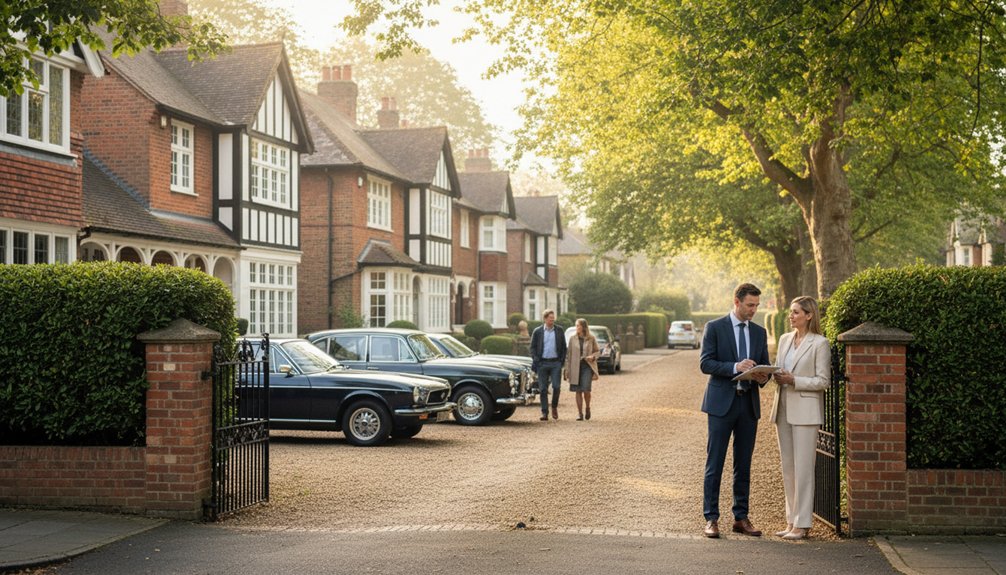
In Amersham’s 2026 market, you’re buying into steady pricing (about £725k typical across HP6/HP7, up 2.1% year-on-year) and station-led demand where well-priced homes often sell in around 46 days. Stock is roughly 12% higher than 2024, so you’ve got more negotiating room, but walk-to-Met Line homes still move fastest. Yields sit near 3.3–3.7% on 2–3 beds. Next, you’ll see what budgets buy and how to win.
Key Takeaways
- Typical sale prices are ~£725k in HP6/HP7, with Old Amersham commanding a premium over Chesham Bois.
- Prices are stabilising, up about +2.1% annually, and the median time to sell is 46 days.
- Stock is roughly 12% higher than 2024, giving buyers more negotiating leverage, especially on relisted or chain-risk homes.
- Best demand is near Amersham and Chalfont & Latimer stations, with London commutes around 35–45 minutes.
- Expect premiums for walkability, parking, and renovations; check damp, structural movement, and lease terms to avoid costly surprises.
Amersham Market in 5 Key Stats (2026)

While national headlines swing between caution and optimism, Amersham’s market in 2026 reads as a steadier, commuter-led story. Track five stats to benchmark your next move and spot Market trends and Investment opportunities.
1) Typical sale price: £725k across HP6/HP7, with Old Amersham consistently higher than Chesham Bois.
2) Annual change: +2.1% year on year, suggesting stabilisation rather than a rebound.
3) Time to sell: 46 days median; best-in-class homes near stations often agree faster.
4) Stock levels: listings sit ~12% above 2024, giving you more negotiating room.
5) Yield: 3.3–3.7% gross for 2–3 beds, strongest around Amersham and Chalfont & Latimer links.
Why Demand Stays High in Amersham
Because you can still commute to London in roughly 35–45 minutes from Amersham or Chalfont & Latimer, demand here stays anchored to rail-led convenience rather than short-term sentiment.
You’re buying into a corridor that keeps attracting time-poor professionals, upsizers, and London-leavers who’ll pay for certainty on journey times and schooling.
Market trends show enquiries concentrate around Amersham-on-the-Hill, Old Amersham character stock, and walkable zones near the Metropolitan Line.
You’ll also see steady interest from cash-rich downsizers who want shops, GP access, and green space without sacrificing connectivity.
Buyer psychology matters: when rates wobble, you don’t pause if the home reduces daily friction—commute, childcare logistics, weekend countryside.
That’s why well-presented, correctly priced homes keep drawing competitive attention year-round.
Why Stock Is Tight (and What It Means for You)
In Amersham, you’re seeing tight stock because fewer owners are listing, upsizers can’t find onward options, and well-priced homes in Amersham-on-the-Hill and the Old Town get absorbed fast.
With limited listings, you can’t rely on a wide choice—speed and certainty tend to beat higher offers.
You’ll need low-stock tactics like mortgage pre-approval, tight shortlists, flexible viewing windows, and a clear position on chain status to compete.
Causes Of Limited Listings
Even though buyer demand in Amersham has stayed resilient, the number of homes coming to market hasn’t kept pace, so stock feels tight across many of the town’s most searched-for pockets.
You’re seeing owners in Amersham-on-the-Hill, Old Amersham, and Chesham Bois stay put because fixed-rate mortgages from 2020–2021 still beat today’s pricing, so moving costs look punitive.
Downsizers also hesitate: bungalows and smaller period cottages are scarce locally, so trading down isn’t straightforward.
At the same time, property investment activity hasn’t disappeared; strong rental demand from London commuters and grammar-school catchment seekers keeps good stock held as long-term lets.
Limited new-build delivery around the town, plus planning constraints near Green Belt edges, further caps fresh listings year-round.
Buyer Strategies In Low Stock
Why does Amersham still feel short of homes to buy when demand hasn’t cooled much? Sellers in HP6/HP7 are holding on to low-rate mortgages, and family homes near Dr Challoner’s and the Met Line get absorbed quickly. With fewer comparable listings, pricing anchors are tighter and best-in-class properties attract competing bids, especially in Chesham Bois and Amersham on the Hill.
You’ll need proactive Market timing: watch for relaunches after failed sales, target midweek viewings, and move fastest on correctly priced stock.
Strengthen your position with proof of funds, a decision-ready solicitor, and a flexible completion window.
In Buyer negotiation, focus on survey-backed fixes and chain-risk discounts, not headline price cuts, and keep offers clean with minimal conditions.
What Your Budget Buys in Amersham (by Type)
How far your budget stretches in Amersham depends as much on postcode and school catchment as it does on property type. The Old Amersham and the Station/Amersham-on-the-Hill areas typically pricing at a premium versus surrounding streets.
For Budget breakdowns by Property types, £500k–£650k often targets 2-bed flats/maisonettes near the station or compact cottages in Old Amersham.
£650k–£900k usually buys 3-bed semis in Amersham-on-the-Hill, with better plots pushing higher.
£900k–£1.3m moves you into 4-bed detached family homes around Chesham Bois/Amersham Common fringes, while character period stock in Old Amersham can sit above band.
Above £1.3m, you’re looking at larger detached houses, gated drives, or acreage on the semi-rural edges toward Mop End and Coleshill.
What “Good Value” Looks Like on This Market
Budget bands give you the rough map, but “good value” in Amersham shows up when the price per sq ft, plot, and catchment stack up better than nearby comparables. You’ll spot it where recent sold data shows a 5–10% discount to the same street’s median, without a compromise on condition or parking.
Track £/sq ft against build quality: refurbished period stock often outperforms tired “done-up later” homes once you price works.
On luxury apartments, value looks like a lower service charge per sq ft, strong EPC, and walkable station access.
For rural estates, you want usable acreage, outbuildings with consent potential, and limited maintenance drag.
If days-on-market is rising but reductions stay shallow, negotiate on fixtures, completion timing, and survey findings, not headline price.
Which Amersham Area Fits Your Lifestyle?
If you’re weighing Old Amersham vs Amersham-on-the-Hill, you’ll see two distinct demand patterns: the Old Town’s period stock and walkable centre trades on character.
While the Hill clusters more post-war homes around the station and shops. Your commute often tips the balance—Amersham station’s Chiltern and Metropolitan links pull buyers toward the Hill, while you’ll trade a longer walk or drive for Old Amersham’s setting.
Schools and amenities then sharpen the choice, so you’ll want to map catchments, compare recent sold prices street by street, and prioritise what you’ll use weekly (high street, parks, cafés, and services).
Old Amersham Vs Amersham-On-The-Hill
While both neighbourhoods sit under the “Amersham” umbrella, Old Amersham and Amersham-on-the-Hill deliver noticeably different day-to-day experiences—and the market data reflects it.
If you’re drawn to Historic architecture, Old Amersham’s period homes and conservation focus typically command a scarcity premium, with tighter stock and faster competition when correctly priced. You’ll also see higher sensitivity to condition and heritage constraints, so pricing spreads widen between turnkey and project properties.
Amersham-on-the-Hill skews toward later-build housing and larger estates, so you’ll often find more consistent comparables and smoother price discovery.
Recent Local market trends show this side reacting faster to rate shifts: listings adjust sooner, and negotiated discounts appear earlier.
Choose Old Amersham for character-led value; pick the Hill for predictability and scale.
Commute, Schools, And Amenities
Character and pricing differences only tell part of the story—your day-to-day will hinge on how quickly you can get to the station, which catchments you sit in, and what you can walk to.
If you’re commuting, Amersham station gives you Metropolitan Line services plus Chiltern Railways to Marylebone; living Amersham-on-the-Hill typically trims your door-to-train time.
Old Amersham buyers trade that for a more village-first routine, often adding a bus, cycle, or drive for peak trains—so compare real commute options by trial runs at 8am.
For families, you’ll watch school rankings closely: Hill-side streets usually sit nearer the strongest primary catchments and Dr Challoner’s Grammar access.
Amenities skew too: Hill offers supermarkets, gyms, and cafés; Old Amersham wins for pubs, boutiques, and heritage walks.
Old Amersham: Character Homes and Price Premiums
Why does Old Amersham keep commanding a premium? You’re buying scarcity: a conservation core where Historical architecture limits supply and keeps values resilient.
Recent sold data typically shows Old Amersham achieving a noticeable uplift over broader Amersham for like-for-like period stock, especially in walkable lanes around the High Street and river-adjacent pockets.
You’ll also see tighter negotiation margins on well-presented cottages, with best-in-class homes often attracting multiple viewings in the first fortnight.
Property renovations drive the next layer of pricing: buyers pay extra for rewired, insulated, and extended layouts that still read “period.”
Watch for premiums on tasteful kitchen-diners, approved loft conversions, and off-street parking solutions—features that reduce risk and shorten your timeline to move-in.
Amersham-on-the-Hill: Schools, Space, Family Streets
Because many buyers prioritise school catchments and day-to-day space over heritage constraints, Amersham-on-the-Hill typically trades on family practicality: 1930s semis, larger detached plots, and quieter cul-de-sacs within easy reach of the station, shops, and parks.
You’ll see the strongest demand on wide, drive-friendly roads where extensions, loft conversions, and home offices add measurable value. Recent sales evidence often shows a clearer premium for square footage, off-street parking, and garden depth than for period detailing.
If you’re targeting school catchment areas, listings near highly rated primaries and grammar feeder routes tighten fastest and negotiate less.
Weekends revolve around Amersham on the hill parks, playgrounds, and sports clubs, so walkability to green space keeps resale risk lower and supports steadier pricing.
Near the Station: Fastest-Selling Commuter Hotspots

While wider Amersham stays buoyant, the fastest-selling listings cluster within an easy walk of Amersham station, where the Metropolitan line and Chiltern Railways compress commute times and widen the buyer pool.
If you target Station Road, Woodside Road, or streets edging Amersham-on-the-Hill’s lower slopes, you’ll see the tightest days-on-market, driven by London-bound demand and reliable public transport frequency.
You’ll also pay a premium for “door-to-platform” convenience, especially for modern flats and compact Victorian terraces that suit hybrid working.
Homes closest to Tesco, cafés, and the High Street’s local amenities attract competitive offers because buyers can live car-light.
Expect best performance for properties that balance parking, quiet backstreets, and a sub-10-minute walk to trains, plus swift access to the A413.
Get Ready to Move Fast: Finance, Solicitor, Survey Plan
Station-adjacent Amersham homes can go under offer in days, so you’ll win more often if you treat readiness as part of your bid: line up your mortgage decision in principle (or proof of funds), instruct a local conveyancer who can turn enquiries quickly on Buckinghamshire leaseholds and common station-area title quirks, and pre-book a surveyor with capacity for short lead times.
Sellers favour buyers who can exchange quickly, and agents in Amersham on the Hill often filter for chain position upfront.
Compare Mortgage options early—fixed vs tracker, higher-LTV vs larger deposit—so your broker can re-quote fast if the agreed price shifts.
For legal preparations, have ID, source-of-funds evidence, and gifted-deposit letters ready, plus a clear completion window, so you can match competitive timelines.
Viewing Checklist for Amersham Homes (Red Flags)
In the Amersham property market, you can’t afford to miss red flags that routinely turn into survey renegotiations—especially hairline cracks, tide marks, and musty smells that point to structural movement or damp.
You’ll also want to verify lease length (if applicable) and boundary lines early, because South Buckinghamshire transactions often slow when title plans, shared drives, or fence lines don’t match what’s on the ground.
Finally, you should test the boiler’s age and pressure, check for recent electrical certification, and scan for plumbing leaks, as upgrade costs have risen and older systems are common in local period stock.
Structural And Damp Warning Signs
Because Amersham mixes older Chiltern-period cottages, mid‑century estates, and newer infill builds, structural movement and damp often show up in different ways—and recent wetter winters and more intense downpours have made moisture-related defects a more common deal-breaker at viewings.
You’ll want to spot Foundation cracks: diagonal stair-step lines around windows, gaps at skirting boards, and doors that suddenly stick—especially on clay-influenced pockets near the Misbourne valley.
Outside, check for bulging brickwork, patched render, and uneven paving that can signal settlement.
For Moisture intrusion, look for tide marks, salt bloom, and blistered paint on chimney breasts and bay walls; sniff for mustiness in north-facing rooms.
Inspect gutters, valley roofs, and flashing—overflow staining after heavy rain is a strong predictor of recurring damp.
Ask when the last damp survey was done.
Leasehold And Boundary Issues
While most Amersham buyers focus on price per sq ft and school catchments, leasehold terms and boundary accuracy can change your true monthly cost—and whether you can extend, alter, or even sell smoothly later.
In newer blocks near Amersham-on-the-Hill and Chesham Road, check remaining lease years; lenders often tighten terms under ~80 years, and extending can add a five-figure premium. Ask for the last three years’ service-charge accounts and any planned major works; your “cheap” flat can jump £150–£300/month.
Scan the management pack for Leasehold disputes, especially arrears recovery, cladding-related claims, or noisy neighbour cases.
For houses around Old Amersham, compare title plans to fences, hedges, and driveways; minor encroachments drive Boundary disputes and delay conveyancing. Also confirm rights of way and parking bays.
Heating, Plumbing, And Electrics
Lease terms and boundary lines can stall a sale, but failed heating, plumbing, or electrics can hit your budget from day one—especially in Amersham’s mix of older cottages in Old Amersham and newer builds around Amersham-on-the-Hill.
Ask for the boiler’s service history and EPC; many buyers now prioritise Heating upgrades to meet rising energy standards and lender scrutiny.
In period homes, check radiators for cold spots, pipework for lead or microbore, and water pressure upstairs—hard water limescale makes Plumbing maintenance a recurring cost.
For electrics, look for an up-to-date EICR, modern consumer unit with RCDs, and evidence of rewiring; older terraces often hide mixed wiring.
Test extractor fans and shower temperature; small faults signal bigger remedial spend.
How to Win an Offer in Amersham (Without Overpaying)
Even if you’re competing against multiple bidders in Amersham—especially around Amersham-on-the-Hill and the stations at Amersham and Chalfont & Latimer—you can still win without stretching your budget by anchoring your offer to recent sold-price evidence, not asking prices. Use Land Registry comps from the past 3–6 months, then adjust for plot size, refurb level, and walk time to the Met line to tighten your property valuation.
Set a ceiling before viewings and stick to it. Lead with smart negotiation tactics: offer a clean timeline, show mortgage/AIP proof, and stay flexible on completion dates. If the vendor wants a headline number, trade terms not price—shorter chain, rent-back, or fewer contingencies.
In today’s price-sensitive market, certainty often beats an extra £10k.
Conclusion
Amersham stays competitive in 2026: low stock, high commuter demand, and best homes near the station moving fastest. You’ll need finance agreed, a solicitor lined up, and a survey plan before you view. Imagine this: you tour a 3-bed in Amersham-on-the-Hill at 10:00, it’s had 12 viewings, and by 16:00 two sealed bids land—one chain-free. You win by bidding clean, not blindly high.