

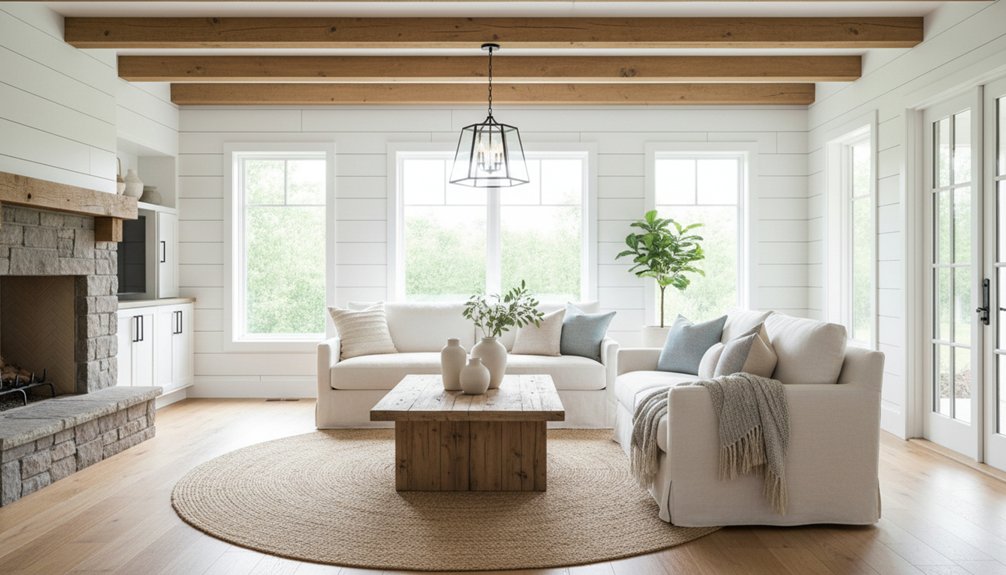
Welcome to our guide to contemporary farmhouse interior decor. Start with simple architectural bones: plain walls, crisp trim, and unfussy floors. Stick to a neutral base of creamy whites, soft grays, or warm beige, then add warmth with oak or walnut and edge with matte black. Choose clean-lined, comfy furniture in cotton, leather, or performance linen, and layer in texture through vintage rugs, linen curtains, and chunky knits. Mix metals with a clear “home base,” and anchor the room with one bold pendant or sconce. Keep going for room-by-room ideas and styling shortcuts.
Key Takeaways
- Start with a consistent neutral base—creamy whites, soft grays, and warm beiges—to keep rooms airy and cohesive.
- Blend clean modern lines with rustic textures using warm woods, simple trim, and unfussy flooring for balanced contrast.
- Edit decor ruthlessly; choose fewer, purposeful pieces and repeat finishes to maintain a calm, collected look.
- Layer texture through rugs, linen curtains, performance upholstery, and subtle patterns to add depth without visual clutter.
- Anchor with sculptural lighting and a tight metal mix—one dominant finish and one secondary—using warm bulbs and dimmers.
Contemporary Farmhouse Style: The 3 Core Rules
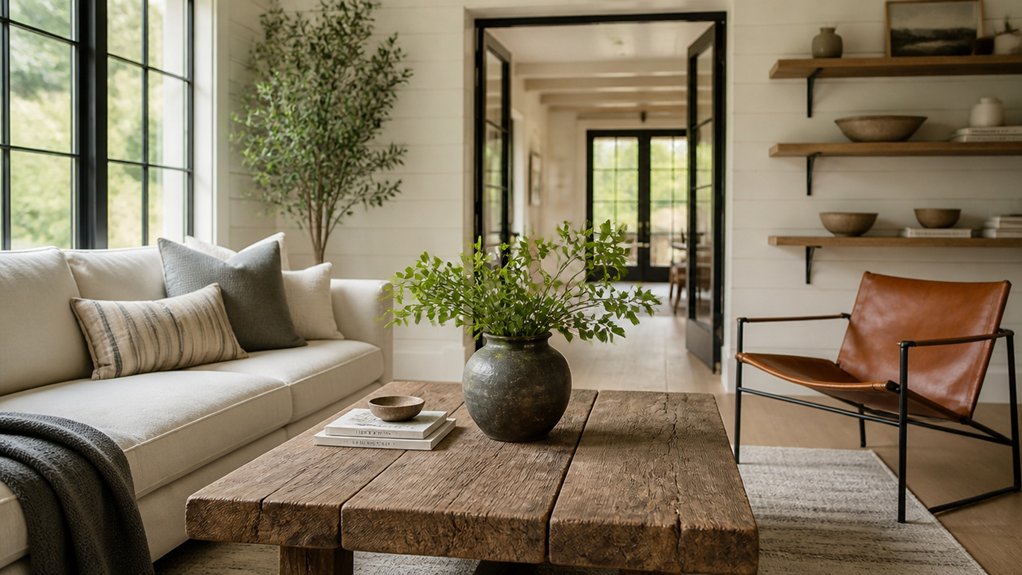
If you want contemporary farmhouse style to feel fresh instead of fussy, you’ve got to stick to three core rules: keep the bones simple, blend clean modern lines with honest rustic textures, and edit hard so every piece earns its place.
Start with quiet architecture—crisp trim, plain walls, and unfussy flooring—so your finishes can breathe.
Then mix: pair a streamlined sofa with a weathered wood coffee table, or matte black hardware against warm oak.
Choose Farmhouse lighting that’s functional and sculptural, like a lantern pendant or thin metal sconce, and keep bulbs warm.
Finally, curate like you mean it. Limit patterns, repeat two or three finishes, and use Vintage accessories sparingly—one croc, one crock, one framed print—so they read intentional.
Contemporary Farmhouse vs. Rustic Farmhouse (Key Differences)
When you compare contemporary farmhouse to rustic farmhouse, you’ll notice the biggest shift in the details.
Contemporary farmhouse keeps clean lines and smooth finishes.
While rustic farmhouse leans into rough textures like reclaimed wood and worn metals.
You’ll also see a palette change—contemporary stays mostly neutral, while rustic warms things up with earthy tones.
Clean Lines Vs. Rough Textures
Although both styles celebrate farmhouse roots, contemporary farmhouse leans into clean lines and a smoother, edited look, while rustic farmhouse embraces rough textures and timeworn character.
If you want the contemporary route, choose streamlined cabinetry, simple trim, and uncluttered surfaces that feel intentional. You’ll get Minimalist contrast by pairing crisp profiles with a few honest, tactile pieces—think a single reclaimed beam or a chunky side table.
If you love rustic farmhouse, let materials show their grit: hand-scraped wood, distressed finishes, visible joinery, and stone with natural variation. You can still keep it livable by limiting rough surfaces to high-impact zones, then balancing them with comfortable upholstery.
Either way, use Textured accents to add depth without letting the room feel busy or heavy.
Neutral Palettes Vs. Earthy Tones
While both farmhouse branches favor natural, livable color, contemporary farmhouse typically sticks to a tight neutral palette—soft whites, warm greys, greige, and matte black accents—to keep rooms bright and edited. You’ll lean on Color psychology here: pale neutrals feel calm, clean, and spacious, so your kitchen and living areas read airy even with chunky furniture.
Add Visual contrast through black hardware, iron lighting, or charcoal window grids, and you’ll keep the look crisp without clutter.
Rustic farmhouse welcomes earthier tones—clay, sage, tobacco, ochre, and weathered wood—so spaces feel grounded and storied. You can layer these hues in textiles, pottery, and stained beams, then temper them with creamy walls to avoid heaviness.
Pick a Modern Farmhouse Color Palette
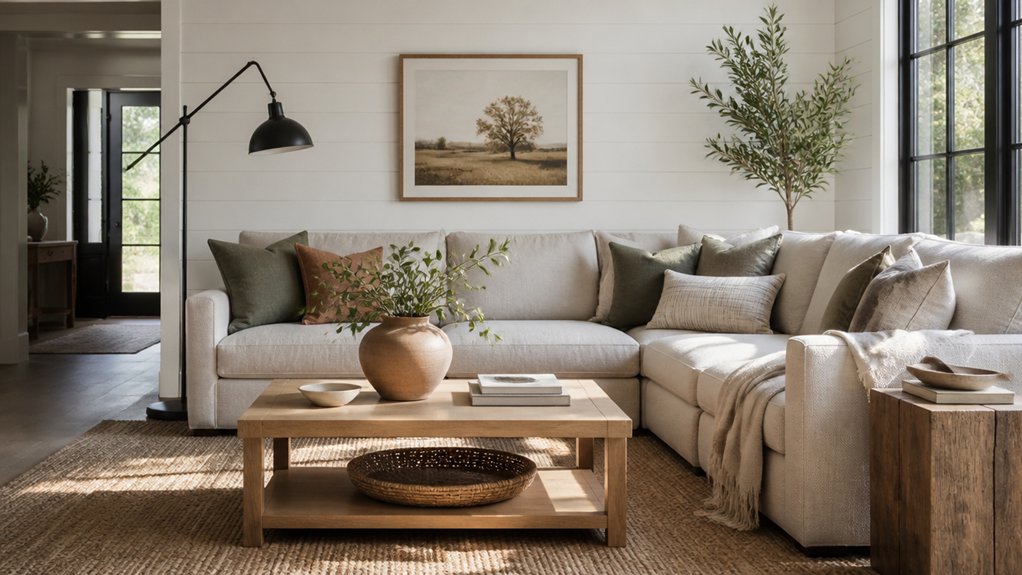
You’ll set the modern farmhouse tone by starting with a foundation of classic neutrals—creamy whites, soft grays, and warm beiges that keep everything calm and clean.
Then you’ll layer in warm woods and crisp blacks to add contrast, structure, and that just-right rustic-modern edge.
Finish by weaving in muted color accents like sage, dusty blue, or clay to bring in personality without crowding the space.
Classic Neutrals Foundation
Because modern farmhouse style thrives on calm, cohesive contrast, a classic neutrals foundation gives you the easiest path to a space that feels both crisp and lived-in. Start with a Neutral base: soft whites, creamy ivories, gentle grays, and muted greige on walls, trim, and larger upholstery so the room reads clean and open.
Then build Texture contrast to keep it from feeling flat. Layer nubby linen, cotton canvas, wool throws, and woven baskets; mix matte paint with subtle sheen on tile or stone. Choose simple patterns like ticking stripes or small checks in washed-out tones to add quiet rhythm.
Keep metal finishes understated and consistent, and repeat your core neutrals across rooms for flow. You’ll get timeless comfort without sacrificing that fresh, contemporary edge.
Warm Woods And Blacks
Once your classic neutrals set that clean, airy backdrop, warm woods and inky blacks bring the modern farmhouse contrast that makes the room feel grounded and current.
Choose oak, walnut, or reclaimed pine for floors, open shelving, and chunky coffee tables, then echo that warmth in woven baskets and leather pulls.
Add black through matte fixtures, window frames, and simple hardware to sharpen edges without feeling stark.
If you want depth, create Farmhouse accent walls with stained shiplap or vertical planks, then outline them with black sconces or a slim picture rail.
Layer in vintage decor—an aged mirror, ironstone crocks, or an old workbench—so the palette feels lived-in, not staged.
Keep finishes low-sheen for a relaxed, durable look.
Muted Color Accents
After you’ve nailed down your whites, creams, warm woods, and matte blacks, muted color accents keep contemporary farmhouse decor from feeling flat while still staying calm. Choose a tight palette: dusty sage, clay, soft denim, or faded terracotta. These shades read lived-in, not loud, and they play well with natural grain and linen textures.
Use Muted color accents in small, repeatable hits—pillows, a vintage runner, pottery, or cabinet hardware—so you build subtle color harmony without clutter. If you paint, try one low-sheen wall or a pantry door instead of the whole room.
Balance every color with plenty of neutral breathing space, then echo it twice elsewhere. You’ll get warmth, character, and a modern farmhouse look that feels effortless.
Choose Clean-Lined Furniture With Warm Materials
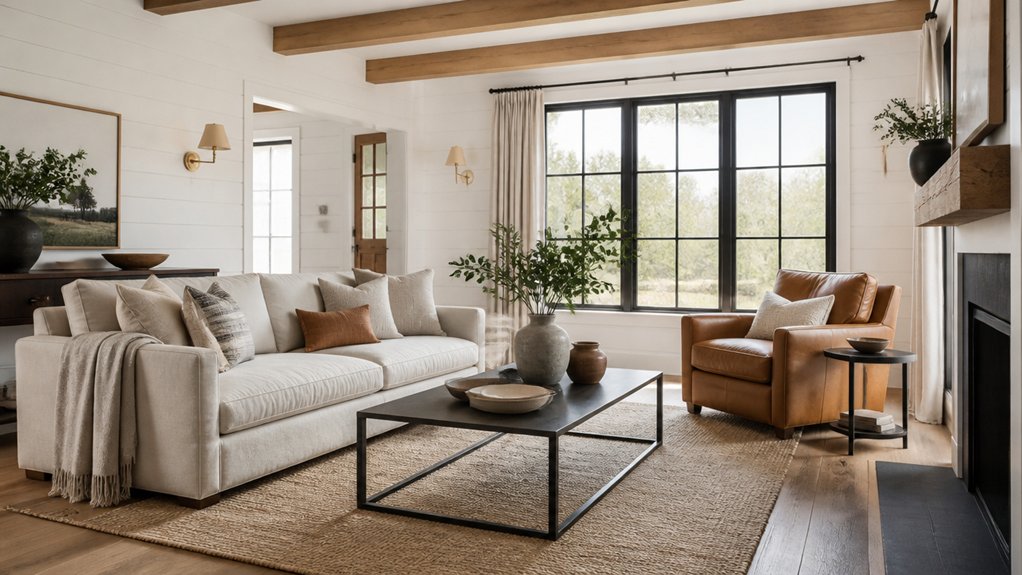
While contemporary farmhouse style leans modern, it still needs that lived-in warmth, so choose furniture with clean, simple lines wrapped in inviting materials. Start with a streamlined sofa or slipcovered settee in cotton or leather, then anchor the room with a solid wood coffee table that shows real grain.
Pick dining chairs with simple profiles, but let oak, ash, or warm walnut do the talking. Add a bench with a sturdy frame for an easy, gathered feel.
For storage, choose Shaker-style cabinets or flat-front credenzas in painted wood, and keep hardware straightforward.
Balance the softness with Industrial accents like matte-black steel legs or a slim metal console.
Finish with Vintage accessories—an old dough bowl or brass candlesticks—to keep it personal.
Add Texture With Rugs, Linens, and Upholstery
Clean-lined pieces and warm woods set the foundation, but texture brings the contemporary farmhouse look to life. Start underfoot with a flatweave or vintage-style rug, then layer a softer jute or wool runner where you stand most. That Textural contrast keeps rooms relaxed, not sterile.
Swap slick fabrics for linen curtains, cotton throws, and a chunky knit blanket you’ll actually use. Choose upholstery that can take real living: performance linen, tightly woven tweed, or a nubby boucle on an accent chair. Add pattern mixing with subtle stripes, ticking, or small-scale checks, then ground it with solids so it doesn’t feel busy.
Finish with a few oversized pillows in varying weaves, and you’ll get depth without clutter.
Mix Woods and Finishes (Undertones + Ratios)
Because contemporary farmhouse balances polish with patina, you can’t treat wood tones and metal finishes as an afterthought. Start by choosing a “home base” wood—often oak, pine, or walnut—and repeat its wood grain in at least two large pieces, like floors and a dining table, so the room feels anchored.
Then layer in one supporting tone with a similar undertone: warm woods pair best with creamy whites and aged, honey stains; cool woods sit cleaner with crisp whites and charcoal. Use finish ratios to keep it intentional: aim for about 70% dominant wood tone, 20% secondary, 10% accent (like a vintage stool or frame).
Finally, match sheen levels—mix matte with matte, satin with satin—to avoid visual noise.
Use Mixed Metals Without Making It Busy
When you mix metals on purpose, you get that rustic-modern farmhouse tension—warmth plus a little edge—without the room feeling scattered. Start with one “home base” finish you’ll repeat most: matte black, brushed nickel, or aged brass.
Then add a second metal in smaller doses, and keep a simple ratio like 70/30 so your eye can rest. Tie the mix together by matching sheen levels (all brushed, all matte) instead of chasing every trend.
Use Mixed metals on hardware, faucets, and small frames, but limit where they show up in a single sightline. Ground the look with wood and stone, and let decorative accents—trays, hooks, and vintage knobs—echo the secondary finish.
You’ll get depth, not clutter.
Choose Statement Lighting (Pendants, Sconces, Chandeliers)
Even if you keep everything else simple, statement lighting instantly sets the tone in a contemporary farmhouse space. Start with one hero piece—an oversized pendant over the island or a clean-lined chandelier above the table—then let it anchor the room’s mix of comfort and edge.
Choose finishes that echo your metal choices, but keep the silhouette bold: matte black, aged brass, or warm bronze work well. Pair vintage fixtures with contemporary designs by looking for updated proportions, clear glass, and streamlined shades.
Add sconces in hallways or beside mirrors to layer light and soften shadows without relying on overhead glare. Pay attention to scale: hang pendants 30–36 inches above a counter, and center chandeliers so they don’t crowd sightlines. Use dimmers for mood.
Style Shelves and Surfaces Without Clutter
After you’ve chosen your statement lighting, keep shelves and surfaces calm by styling them with intention, not piles.
Build curated shelf vignettes—one anchor piece, a couple of supporting items, and a touch of greenery—then repeat with variation.
Layer decor with breathing room so each texture reads clean and the whole space feels airy and lived-in.
Curated Shelf Vignettes
Because your shelves and surfaces work hardest in a contemporary farmhouse home, curated vignettes keep them feeling intentional instead of cluttered. Start with one anchor piece, like a pottery pitcher or framed print, then build around it with two to four supporting items you love.
Mix Vintage accessories—an old brass candlestick, a weathered book stack, a small enamel box—with a modern element like matte-black hardware or a clean-lined vase. Add botanical arrangements for life and softness: clipped greenery in a stoneware jar, dried stems in a clear bottle, or a single branch in a crocks. Keep your palette tight, repeat one material (wood, iron, glass), and vary height for movement.
Step back, edit one item, and you’ll keep it calm and collected.
Layered Decor With Space
When you layer decor with breathing room, your shelves and surfaces look collected, not crowded. Start with one anchor per area—an oversized bowl, a framed print, or a crock—then build around it in odd numbers. Leave at least a hand’s width of open space so each piece reads clearly.
Use height and depth to create calm contrast: stack two books, lean art behind, and place a small object up front. Add warmth through layering textiles, like a folded linen runner under a tray or a knit throw on a bench, but keep colors tight and textures varied.
Practice space optimization by corralling small items in baskets or trays, and edit weekly: if it doesn’t serve function or story, move it out.
Room-by-Room Ideas: Kitchen, Living, Bed, Bath
Even if you love the contemporary farmhouse look, it lands best when you tailor it to each room’s daily rhythm—so start with a few consistent anchors (warm wood, clean-lined furniture, matte black or aged brass hardware, and layered natural textiles) and then adjust the mix for how you cook, lounge, sleep, and refresh.
In the kitchen, pick Farmhouse kitchen layouts that keep traffic clear: an island with slim stools, open shelves for daily dishes, and a deep apron-front sink.
In the living room, balance a crisp sofa with a worn-wood coffee table, a chunky knit throw, and one oversized landscape.
For the bedroom, choose bedroom color schemes that calm—creamy whites, clay, sage, or charcoal—then add linen bedding and blackout woven shades.
In the bath, pair simple tile with a vintage-style mirror, wall hooks, and soft towels.
Conclusion
You’ve got everything you need to make contemporary farmhouse feel fresh, calm, and lived-in. Stick to the three core rules: keep lines clean, materials warm, and styling simple. Choose a modern palette, layer texture with rugs and linens, and mix metals with intention. Let one bold light fixture do the talking, and keep shelves edited, not empty. Carry those moves room to room, and your home will feel a million times more welcoming.