


Guildford house prices still reward you most for location: walkable access to the station, town centre, and top school catchments (especially in GU1–GU2) typically commands a clear premium. Over the last 12 months, growth has cooled, decision times have lengthened, and the gap between asking and achieved prices has tightened, so clean, finance-ready offers can win terms. Compare micro-markets street by street, and scrutinise flats for lease length and service charges. Next, you’ll see what to check before you offer.
Key Takeaways
- Prices are strongest near Guildford station, town centre, A3 access, and green spaces; walkability and safety typically command a premium.
- School catchments can add significant premiums; always verify current admissions boundaries and recent cut-offs before offering.
- Flats are pricing-sensitive; compare lease length, service charges, ground rent, parking, and EPC ratings to avoid overpaying.
- Period terraces and family semis in prime streets stay resilient, while larger or luxury homes face more negotiation and longer selling timelines.
- Expect slower growth and a narrower list-to-sale gap; clean, proceedable offers with finance ready can secure better terms.
Guildford House Prices: Today’s Snapshot
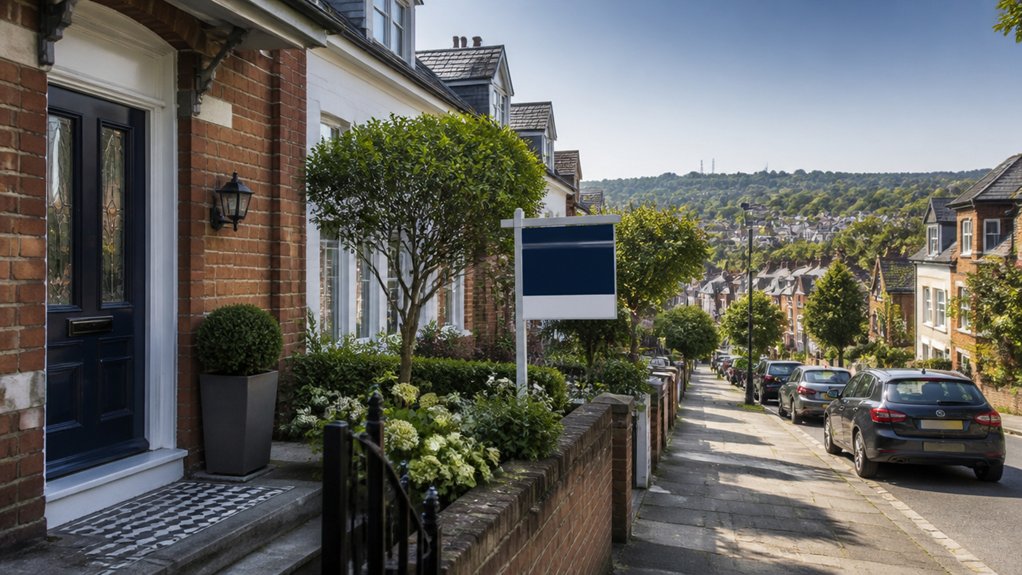
While the national market’s been choppy, Guildford house prices still reflect strong local demand, especially around the station, town centre, and sought-after school catchments. You’ll see the best-kept period terraces and family semis holding firm, because commute convenience and school access stay scarce.
Flats can price more sensitively, so you need to compare like-for-like on lease length, service charges, and parking. Use Historical market trends to anchor your offer: check how similar streets performed across past cycles, not just last quarter’s listings.
Buyer psychology matters too—vendors often test optimistic pricing, then respond fast to clean, proceedable bids. If you’ve got finance agreed and chain risk low, you can negotiate on condition, extensions, and EPC performance.
What’s Changed in the Last 12 Months
Over the last 12 months in Guildford, you’ve likely seen price growth lose momentum as the market cools from its earlier highs. Buyer demand has shifted too—some segments stay competitive while others give you more negotiating room.
Inventory levels are the other key change, and as listings rise or tighten, you’ll feel it directly in choice, pricing power, and time on market.
Price Growth And Cooling
As interest rates settled and buyer budgets tightened, Guildford’s housing market shifted from last year’s rapid gains to a more measured pace. You’ll notice price growth hasn’t disappeared, but it’s cooled: sellers can’t bank on automatic bidding premiums, and you can negotiate with stronger footing on comparable evidence.
Track Market trends by micro-area: central Guildford holds up better than fringe pockets, while larger family homes show the sharpest slowdown.
For your affordability analysis, stress-test repayments against today’s mortgage pricing and focus on value per square foot, condition, and EPC rating.
In the last 12 months, price expectations have become more realistic, and the gap between “aspirational” list prices and achieved prices has narrowed. If you’re buying now, you can prioritise fundamentals and avoid overpaying for hype.
Buyer Demand And Inventory
Cooling price growth has reshaped the balance of power in Guildford, and you can see it most clearly in demand and stock levels. Over the last 12 months, urgency has eased: fewer sealed-bid scrambles, more second viewings, and longer decision windows, especially for family houses near top schools.
At the same time, listings have thickened as would-be movers test the market, giving you more choice and more time to compare like-for-like streets. These market trends shift buyer psychology from “grab it now” to “prove the value.”
You can push harder on price, request surveys sooner, and negotiate repairs or credits without losing the deal. Still, the best-presented homes in central Guildford and around the station move quickly, so act fast when condition and commute line up.
What Drives Guildford House Prices (The Big 5)
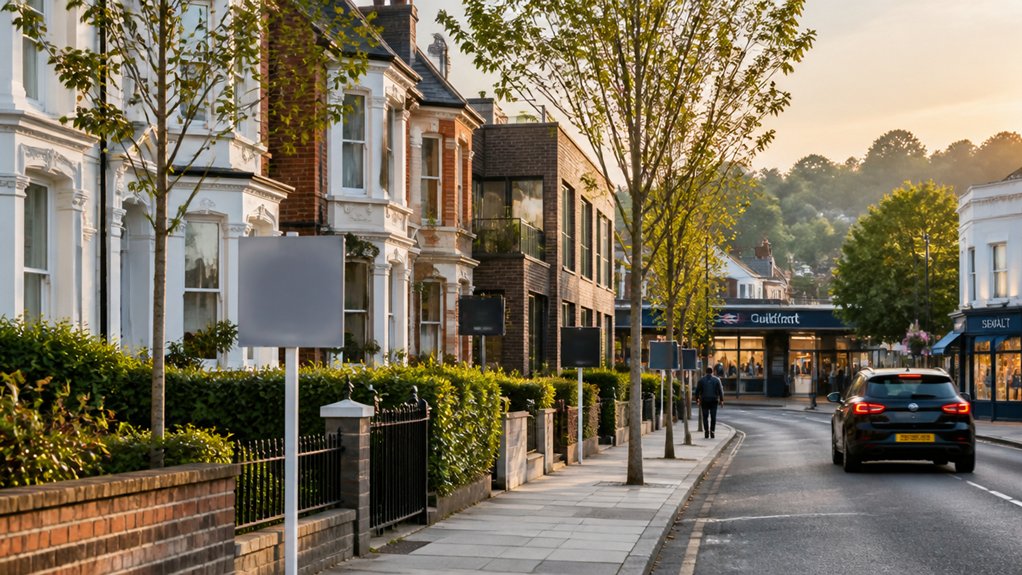
In Guildford, you’ll see price differences quickly once you compare location and transport links—especially walkable access to London Road, Guildford, and key A3 routes.
You’ll also feel the premium when you target sought-after school catchments, because demand tightens and competition rises.
If you want to pay the right price, you need to weigh commute convenience and catchment strength before you shortlist.
Location And Transport Links
Although two homes might share the same square footage, Guildford’s location and transport links can put one miles ahead on price because buyers pay a premium for time-saving connectivity. If you can walk to London Road or Guildford station, you’ll often see sharper asking prices and quicker sales, especially for period terraces and modern apartments.
You’ll also pay more for easy A3 access without constant traffic noise, so check approach roads at peak times. Factor in bus routes into town, cycle links, and whether the High Street feels like a 10-minute stroll or a 25-minute trek.
Local amenities matter: a nearby supermarket, cafés, and green spaces boost day-to-day value. Finally, neighborhood safety shapes demand; well-lit streets and active community feel reduce perceived risk and support pricing.
School Catchments And Demand
When you buy in Guildford, school catchments can shift a home’s value as much as its postcode, because families compete hard for the right intake area. If you target top-rated primaries or sought-after secondaries, you’ll often pay a premium for streets that sit safely inside the boundary.
Before you bid, you should check the latest admissions maps, sibling rules, and distance tie-breaks, because a “nearby” address can still miss out. Compare Historical price trends on catchment-edge roads versus firmly in-zone roads to see where buyers overpay.
Then use Market forecasting: planned housing, academy changes, and intake expansions can soften premiums, while tightening admissions can lift them. If you need flexibility, focus on homes that still work even if the line shifts.
How Mortgage Rates Change Your Buying Power
Because lenders price your monthly payment off the interest rate, even a small shift in mortgage rates can dramatically change how much Guildford property you can afford.
If rates rise, the same income supports a smaller loan, so you may need to target different streets, property types, or renovation levels to stay within budget.
If rates fall, you can stretch price, reduce your deposit pressure, or keep the purchase price steady and improve cashflow.
Track Mortgage rates alongside local affordability trends: when lenders tighten stress tests, your borrowing limit can drop faster than headline prices.
Get an Agreement in Principle early, model payments at several rate scenarios, and prioritise fixed vs tracker based on your time horizon and risk tolerance.
This keeps negotiations grounded and prevents surprises at offer stage.
Supply and Competition in Guildford Right Now

As more Guildford sellers test the market but the best-located homes still attract multiple offers, you’ll feel supply and competition vary sharply by postcode, school catchment, and commuting convenience.
Expect best-in-class family houses to move fastest: they’re priced tightly, launch midweek, and go “best and final” quickly when several proceedable buyers line up.
You’ll see more choice in larger stock and in blocks offering Luxury apartments, yet discounts remain selective and condition-led.
New-build incentives can help, but watch service charges, ground rent terms, and resale comparables.
For character, Historic estates and period homes trade on scarcity; surveys often uncover costly quirks, so budget for works.
To compete, line up finance, instruct a solicitor early, and move decisively on well-presented listings.
Guildford House Prices by Area and Postcode
Now you’ll want to compare Guildford house prices by area and postcode, because a few streets can shift values dramatically.
You can quickly spot hotspots and better-value pockets by weighing GU1 vs GU2, and town-centre premiums against village-edge pricing.
Next, you’ll see where your budget stretches furthest and which postcodes tend to hold value best.
Postcode Price Comparisons
Where you buy in Guildford can shift the price tag dramatically, and postcodes make those differences easy to spot. Use postcode-level sold-price data to benchmark any viewing, because a few streets can skew averages and affect what “good value” means.
In GU1, you’ll often see higher flats-to-houses mix, so compare like-for-like and check recent reductions.
GU2 can price in commuter access and student-demand dynamics, so watch Market trends around rental yields and turnover.
GU3 and GU4 typically show more space-for-money, but wider spreads mean you must filter by property type, age, and plot size.
GU5 and GU6 can command premiums for larger homes, so stress-test affordability against lending rates.
Build Investment strategies around the postcode’s transaction volume, not asking prices.
Area Hotspots And Values
Postcodes give you the price framework, but the real swing comes when you map those numbers to specific Guildford hotspots. In GU1, town-centre fringe streets and riverside pockets often command a premium for walkability and station access.
GU2 can look better value, but you’ll pay more near university edges and established family roads with bigger plots.
GU3 and GU4 typically stretch your budget further; watch for village cores and good school catchments where competition tightens quickly.
In GU5, the Surrey Hills pull adds scarcity pricing, especially for character homes and views.
Use Historical trends to spot streets that outperformed in past cycles, then test Market forecasts against supply: where listings stay thin, sellers keep leverage.
Town Centre vs Outskirts: What You Pay For
Although Guildford’s centre puts you within walking distance of the High Street, the station, and the best café-and-culture buzz, you’ll typically pay a clear premium per square foot for that convenience—often trading garden space and parking for period character, quicker commutes, and stronger rental demand.
While the outskirts usually stretch your budget further with larger plots, easier driveways, and a calmer feel, there is a trade-off at the cost of longer peak-time journeys and fewer amenities on your doorstep.
In the centre, you’re competing for turnkey homes, Luxury apartments, and character conversions near the river and Castle grounds, so pricing stays resilient.
Move out toward Burpham, Merrow, or Onslow Village, and you’ll often buy more space for the same money, including family-friendly streets and access to historical estates nearby.
You’ll still want to price in school runs, A3 access, and parking pressure.
Guildford House Prices by Property Type
Once you’ve weighed town-centre convenience against extra space on the outskirts, the next factor that really moves the dial is property type—because Guildford’s pricing splits sharply between flats, terraces, semis, and detached family homes.
Entry-level flats cluster around the station, Stoke, and central blocks; they’re your best route in, but service charges can bite, especially in luxury apartments with lifts, gyms, and concierge.
Period terraces in Charlotteville and around Onslow Village trade on character and walkability, so you’ll often pay a premium per square foot.
Semis in Merrow and Burpham usually offer better space-to-price balance and scope to extend.
Detached homes command the widest range: expect top-end pricing where plots are larger and finishes turnkey.
For a different value curve, rural cottages near Shalford or Peasmarsh can look attractive—until renovation costs land.
How School Catchments Affect Guildford Prices
Because families chase proven results and shorter school runs, catchment lines in Guildford often act like invisible price multipliers. If you’re targeting top-performing primaries or sought-after secondaries, you’ll often pay a premium for homes that sit safely inside preferred catchment zones, even when the property’s size and finish match nearby options.
School zoning can be tight and periodically adjusted, so you can’t rely on postcode assumptions. You’ll need to check current admissions maps, historical cut-offs, and whether a street regularly falls inside the intake.
If you buy on the boundary, price volatility can rise because demand hinges on one policy change. Use catchment certainty as leverage: weaker zoning usually means more negotiating room and longer selling times later.
How Transport Links Affect Guildford House Prices
School catchments can nudge values street by street, but in Guildford, transport links often set the baseline for what buyers will pay.
If you can walk to Guildford or London Road stations, you’ll usually see sharper pricing and faster resale, because commuters prize the quick run into Waterloo and easy connections across Surrey.
You’ll also pay a premium near strong bus corridors and Park & Ride access, where Public transport cuts the need for a second car.
Look at how close you’re to the A3 without sitting on it: easy slip-road access helps, but traffic noise discounts.
Finally, cycling infrastructure matters more each year; direct, safe routes into town and to the university widen your buyer pool and support values even in slower markets.
Pre-Offer Checks: Surveys, Leases, Flood Risk
While the asking price tells you what a seller wants, your pre-offer checks show what the home’s really worth in Guildford. Book Pre offer inspections early, especially on Victorian terraces near the town centre and older stock in Stoughton, where damp, roof wear, and outdated electrics can bite.
Use RICS property surveys to price in repairs and renegotiate before you’re emotionally committed.
If it’s leasehold—common around the station and some riverside blocks—scrutinise the unexpired term, ground rent, service charges, and planned works; short leases can crush mortgage options and resale value.
Finally, check flood risk: the River Wey and low-lying Burpham patches need more than a quick map look. Ask for past claims, drainage reports, and insurance quotes before offering.
Conclusion
You’ve seen how Guildford prices move with rates, supply, schools, and rail links, so you can buy with eyes wide open. Treat the local market like a compass: it won’t choose the home for you, but it will keep you off course. Lock in your budget, target the right neighbourhood and catchment, and stress-test any lease or flood risk before you offer. Move fast when value appears, and negotiate hard.