


You avoid cowboy builders by checking recent comparable projects and judging how clearly they document assumptions and respond. Verify licences and insurance with issuing bodies and insurers, and validate reviews through independent sources and direct references. Compare itemised quotes on identical drawings, challenge low allowances, and treat missing detail as risk. Use a written contract with milestone-based payments, strict variation rules, and defined snagging. The next sections outline a deeper, step-by-step approach.
Key Takeaways
- Vet builders by comparing recent similar projects, asking targeted scope questions, and judging response speed and documentation quality.
- Verify credentials: confirm licences, insurance policies with the insurer, business registration, and check for disciplinary or insolvency records.
- Compare quotes like-for-like using the same drawings and specs; treat vague “all-in” pricing, missing details, and heavy provisional sums as red flags.
- Demand a written contract defining scope, quality standards, payments tied to milestones, and a signed variation process before extra work starts.
- Check references directly and validate reviews independently, focusing on punctuality, defect resolution, and change control against budget and schedule.
Vet a Builder Fast (Fit, Comms, Questions)
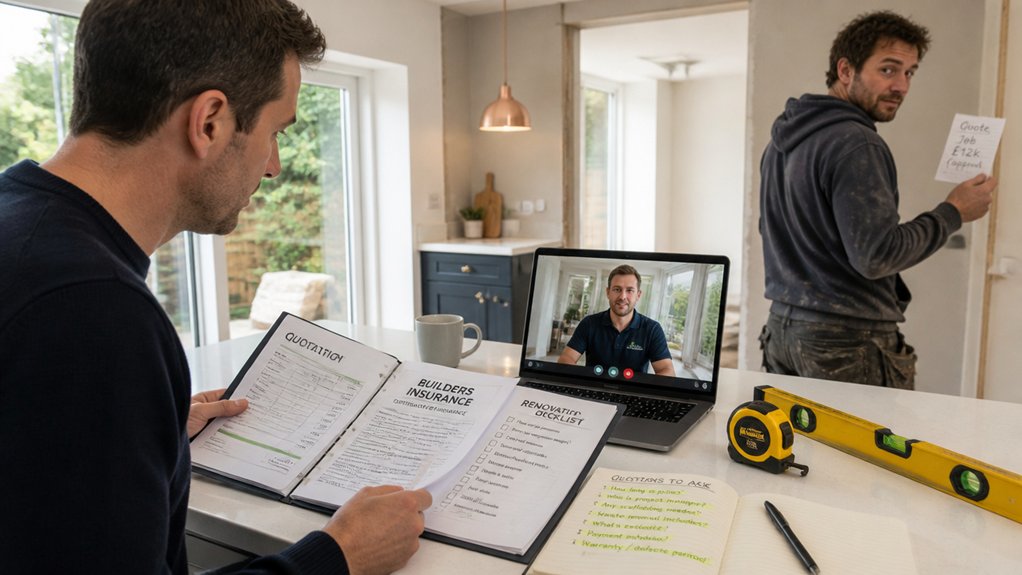
Before you accept a quote, you can vet a builder quickly by checking three essentials: fit for the job, communication quality, and how they answer targeted questions.
Confirm fit by matching their recent work to your scope, methods, and constraints; ask for comparable projects, not generic claims.
Test communication by tracking response times, clarity, and whether they document assumptions in writing.
Use targeted questions: what’s excluded, who supervises daily, how variations get priced, and what dependencies exist.
Request a draft project timeline with milestones, lead times, and access requirements; inconsistencies often signal weak planning.
Conduct reference checks focused on reliability: punctuality, defect resolution speed, change control discipline, and adherence to the timeline and budget.
If answers stay vague or defensive, you should walk away.
Verify Contractor Credentials (Insurance, Licences, Reviews)
Although a tidy portfolio and confident pitch can look convincing, you still need to verify credentials because insurance, licensing, and independent feedback determine whether a contractor can legally work, manage risk, and stand behind defects.
Request evidence of public liability and, where relevant, employers’ liability, then perform insurance verification by calling the insurer to confirm policy status, limits, exclusions, and expiry dates.
Conduct license checks with the issuing authority, not screenshots, and confirm the licence class matches your project type.
Ask for trade-body membership numbers and check disciplinary history, insolvency records, and registered business details.
Validate reviews using independent platforms, look for consistent timelines, and prioritise detailed feedback over star averages.
Finally, request recent client references and contact them directly to confirm workmanship, aftercare, and defect resolution.
Compare Contractor Quotes (Scope, Allowances, Red Flags)
When you compare contractor quotes, you’re not just weighing prices—you’re testing whether each builder has defined the same scope, priced the same risks, and allowed realistically for unknowns.
Demand Scope clarity: itemised work sections, materials, specifications, exclusions, and assumptions, all aligned to the same drawings and survey notes.
Check allowances (prime cost items, provisional sums) for realism; low allowances often shift true cost into later variations.
Require quantified labour, programme duration, waste disposal, and access or protection measures, so you can compare like-for-like.
Treat missing details as risk, not savings.
Use Red flag indicators: vague “all in” pricing, unusually short timelines, refusal to explain rates, heavy reliance on provisional sums, and inconsistent VAT or contingency treatment.
You should also confirm who supervises daily and what subcontractors are included.
Use a Home Renovation Contract (Payments, Changes, Snagging)
Comparing quotes only tells you which builder *says* they’ll deliver the right scope for the right price; a written home renovation contract sets the rules that make that promise enforceable.
Specify drawings, inclusions, exclusions, and quality standards, then define Legal safeguards such as insurances, warranties, and responsibility for permits.
Set Payment schedules tied to measurable milestones (e.g., demolition complete, first fix signed off), not calendar dates, and require invoices and receipts for allowances.
Control changes with a variation procedure: written instruction, priced impact, and time adjustment agreed before work proceeds.
Include a snagging and defects process: inspection dates, retention, completion criteria, and rectification deadlines.
You’ll reduce ambiguity, limit leverage, and keep progress auditable throughout the build.
If a Contractor Goes Bad: Steps for Disputes and Recovery

If your contractor’s work slips into delay, defective workmanship, or non-performance, you need a structured dispute pathway that protects your position and preserves evidence. You should document progress, defects, and communications, then issue a written notice citing the contract, required standards, and a clear cure deadline.
Don’t pay further sums beyond agreed milestones, and secure the site to prevent loss or damage. Obtain an independent inspection report and a quantified schedule of remedial works to support valuation.
You should then propose dispute resolution: negotiation, mediation, or adjudication, depending on the contract and jurisdiction. If settlement fails, you can escalate to legal remedies, including withholding, set-off, termination, recovery of rectification costs, and court or arbitration.
Notify insurers, lenders, and relevant trade bodies promptly. Maintain a single evidence file.
Conclusion
Think of your renovation as crossing a desert with a hired guide. You don’t follow the loudest rider; you verify the map, the water, and the route. You screen for fit and communication, then confirm insurance, licences, and credible reviews. You compare quotes by scope and allowances, not headline price. You bind the journey with a contract covering payments, variations, and snagging. If the guide strays, you document, notify, escalate, and pursue recovery methodically.