

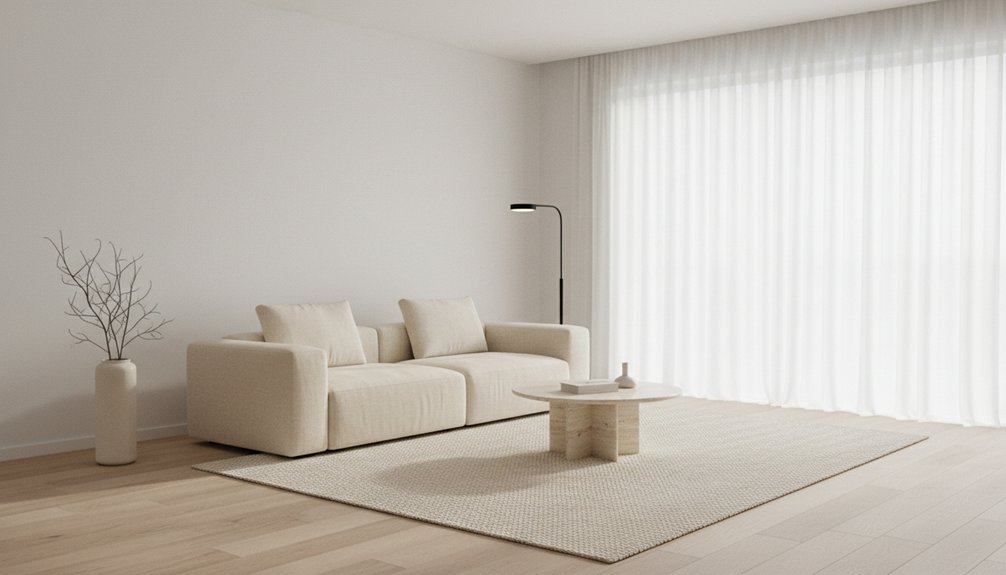
Welcome to our guide to minimalist interior design. Start by decluttering room by room using trash, donate, relocate, and keep, and follow a one-touch rule to stop new piles. Set hard storage limits per category and group items by task and frequency so surfaces stay sparse. Build a warm minimalist palette with off-white or greige, sand or taupe, one earthy accent, and a dark anchor. Choose slim, raised-leg furniture that earns its footprint, add hidden storage, and layer 2700K–3000K lighting plus natural textures. Keep going to see how to fine-tune each step.
Key Takeaways
- Declutter room by room using trash, donate, relocate, keep, and follow a one-touch rule to prevent new piles.
- Set hard storage limits per category and store items by task and frequency, keeping surfaces intentionally sparse.
- Build a warm minimalist palette with off-white or greige bases, earthy accents, and dark contrasts, testing swatches in varied lighting.
- Choose fewer, better furniture pieces with light silhouettes and multifunctional features, planning clear walkways, sightlines, and door swings.
- Layer warm 2700K–3000K lighting with dimmers and add tactile textures like wool rugs and linen drapes to keep minimalism inviting.
Start With a Minimalist Declutter Plan

Before you buy anything new, commit to a minimalist declutter plan that clears visual noise and defines what truly belongs in the space. Walk room by room with a timer, and use decisive Decluttering techniques: trash, donate, relocate, or keep. Apply a “one-touch” rule so you don’t create new piles.
Measure storage capacity, then set hard limits per category—linens, books, cookware—so quantity matches your cabinets, not wishful thinking.
Next, lock in Organizing strategies that support daily flow. Group items by task, store by frequency of use, and keep surfaces intentionally sparse. Standardize containers, label discreetly, and route cords to reduce visual fragmentation.
Finish with a maintenance cadence: weekly reset, monthly review, and a strict one-in-one-out policy.
Pick a Warm Minimalist Color Palette (3–5 Tones)
Once you’ve cleared the clutter, choose a warm minimalist palette of 3–5 tones to keep the room calm without feeling stark. Start with an off-white or soft greige base, then layer a warm mid-tone like sand, camel, or taupe for depth.
Add one muted earthy accent—terracotta, olive, or clay—to guide the eye without visual noise. Plus, include a grounding dark such as espresso or charcoal for contrast.
Use Color psychology to match function: creamy neutrals read inviting, while soft earth tones signal stability and ease. For mood enhancement, keep saturation low and undertones consistent (all warm or all balanced).
Test swatches morning and night; lighting can flip a “warm” beige cool. Keep finishes cohesive: matte walls, natural textiles, subtle sheen.
Choose Furniture That Earns Its Footprint
With your warm minimalist palette set, let furniture choices reinforce that calm by limiting the room to pieces that solve real needs and scale to the space. Start by measuring walkways, sightlines, and door swings, then choose silhouettes that feel light: raised legs, slim arms, and tight backs.
Prioritize dual-purpose comfort over extra seating you won’t use; a well-proportioned sofa and one accent chair often outwork a sectional. Select Eco friendly materials like FSC-certified wood, recycled metal, linen, or low-VOC finishes for a cleaner, current look.
Add personality through Vintage accents—a restored teak side table or sculptural lamp—so you get character without clutter. Keep spacing deliberate; negative space is your best “furniture” for breathing room.
Use Hidden Storage to Keep Surfaces Clear
Keep your countertops, consoles, and nightstands visually quiet by shifting everyday clutter into storage that’s built into the architecture—think banquettes with lift-up seats, toe-kick drawers, and recessed shelving.
Choose furniture with concealed compartments, such as ottomans with hidden wells, beds with drawer bases, and nesting tables that stash tech and remotes out of sight.
Upgrade with streamlined closet organizers—modular drawers, pull-out trays, and vertical dividers—so everything has a place and your surfaces stay clear.
Built-In Storage Solutions
A few well-placed built-ins can transform cluttered rooms into streamlined, high-function spaces by shifting everyday items off exposed surfaces and into hidden storage. Start by mapping what lands on counters, consoles, and nightstands, then assign each category a dedicated zone behind clean fronts.
Use Modular cabinetry to create a flush wall of storage that visually recedes; align reveals, minimize hardware, and match paint or veneer to surrounding surfaces. Add Innovative shelving inside closets or niches so you can adjust heights as needs change, keeping volume tight and efficient.
Consider toe-kick drawers, integrated filing slots, and tall utility cabinets for brooms and vacuums. Prioritize full-extension slides and soft-close hinges for quiet performance. When everything has a concealed home, your surfaces stay clear and your rooms feel intentionally calm.
Furniture With Concealed Compartments
Three smart pieces can do the work of an extra closet: choose furniture with concealed compartments—lift-top coffee tables, storage ottomans, and platform beds with drawers—to stash the items that usually sprawl across your surfaces.
Prioritize models with soft-close hardware and a flush profile so they read as clean, not bulky.
In the living room, a lift-top table hides remotes, chargers, and paperwork while giving you a laptop-height work surface. A tailored ottoman swallows throws and games, then doubles as seating.
In the bedroom, under-bed drawers keep off-season linens out of sight without adding extra casegoods. Look for hidden compartments that align with your daily routines, and treat multifunctional furniture as your first line of clutter control.
Streamlined Closet Organizers
Where does the visual noise in your room actually start—on the dresser, or inside an overstuffed closet? When your closet overflows, you’ll stack “temporary” piles on chairs, shelves, and countertops. Streamlined closet organizers stop that cascade by giving every item a designated, hidden home.
Start with Custom closet accessories: low-profile velvet hangers, pull-out trouser racks, slim shoe drawers, and lidded bins sized to your shelf depth. Add a top-shelf drop zone for off-season storage, then keep daily essentials at eye level.
Use clothing categorization techniques that mirror your routine—work, workout, weekend, and occasions—then sub-sort by color to reduce decision fatigue. Finish with labeled dividers and a small donation bin so editing stays automatic. Your surfaces stay clear, consistently.
Layer Lighting to Make Minimalism Feel Cozy
Even if you’ve pared back furniture and decor to the essentials, layered lighting keeps minimalism from feeling cold by adding depth, warmth, and control. Start with a dimmable ceiling fixture or recessed cans to set an ambient glow without visual clutter.
Then add task lighting where you work: a slim reading lamp by the sofa, an under-cabinet strip in the kitchen, or a focused desk light.
Finish with accent sources to shape layered shadows—picture lights, toe-kick LEDs, or a small uplight that washes a wall. Choose warm white LEDs (2700K–3000K) and keep finishes consistent for a cohesive look.
Put key zones on separate switches or smart scenes so you’ll shift from bright daytime to calm evening instantly.
Add Texture With Rugs, Wood, and Textiles

Although minimal interiors rely on clean lines and open space, you can keep them from feeling flat by dialing up texture through rugs, natural wood, and thoughtfully chosen textiles. Start with a low-pile wool rug to define seating without visual clutter; add a second, smaller jute or sisal layer for tonal contrast.
Bring in warmth with white oak, walnut, or ash—think a slatted bench, floating shelves, or a ribbed cabinet front that catches light. Choose fabrics with subtle dimension: bouclé pillows, linen drapery, and layered textile throws in a tight palette to maintain restraint.
If walls feel bare, use Textured wall accents like limewash, micro-cement, or acoustic panels for depth. Keep finishes matte, edges crisp, and textures varied, not busy.
Conclusion
When you follow this minimalist plan, you’ll feel like you’ve doubled your square footage overnight. Declutter with intention, then lock in a warm 3–5 tone palette that keeps every room calm, not cold. Choose furniture that truly earns its footprint, and hide the rest behind smart storage so surfaces stay pristine. Layer lighting for softness, then finish with texture—rugs, wood, and textiles—so your “simple” space looks impossibly rich.