

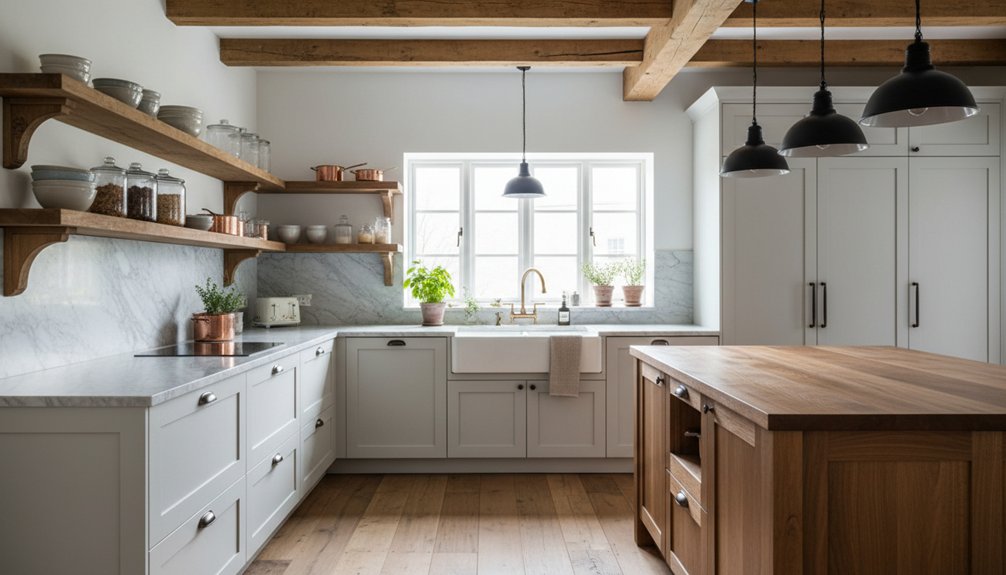
Modern rustic kitchen styling works when you start with clean-lined cabinets (slim Shaker or flat-front oak), then add one or two rustic anchors like reclaimed wood shelves and honed stone counters. Keep your palette tight—soft white or warm greige with muted greens, matte black, and warm wood tones—so texture does the talking. Layer lighting with recessed, vintage-inspired pendants, and under-cabinet strips. Style surfaces sparingly with ceramics and boards; there’s more ahead to refine each choice.
Key Takeaways
- Blend modern clean lines with rustic textures like weathered wood, honed stone, and handmade ceramics for balanced, timeless contrast.
- Choose flat-front or slim Shaker cabinets in matte whites or warm greiges, paired with oak or walnut accents for depth.
- Use durable, tactile surfaces: honed quartz or soapstone, sealed butcher block, and textured backsplashes like tumbled brick or artisan tile.
- Layer lighting with recessed, statement pendants, and under-cabinet strips; repeat finishes in matte black, aged brass, or iron for cohesion.
- Keep styling curated and clutter-free: mix open shelving with hidden storage, avoid theme decor, and rely on a restrained neutral palette.
Define the Modern Rustic Kitchen Look
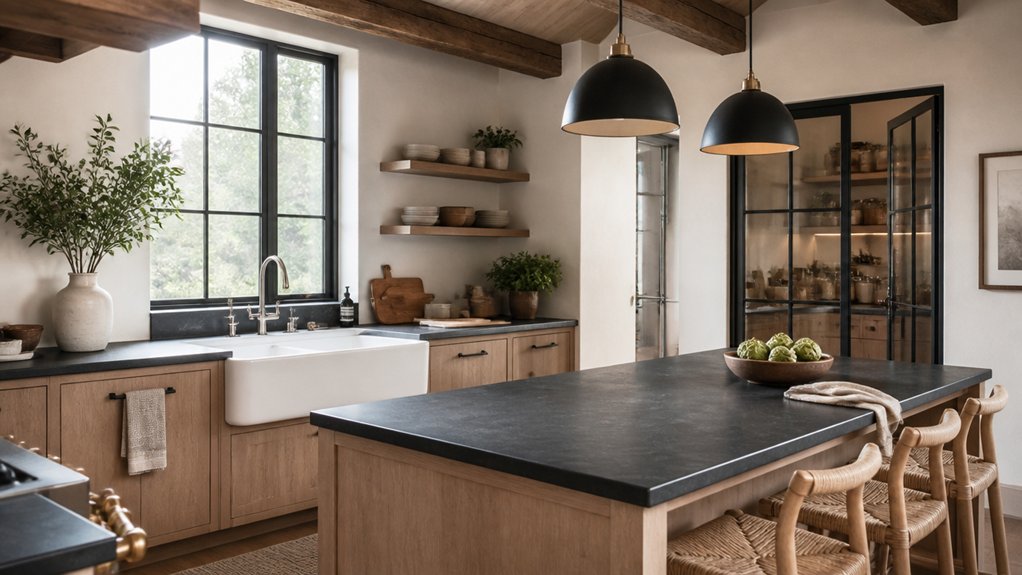
Modern rustic kitchen styling blends two distinct vibes: the clean, streamlined polish of modern design and the lived-in warmth of rustic materials. You’ll see crisp lines paired with character-rich textures—think matte finishes beside weathered wood grain, or smooth stone next to hand-thrown ceramics.
The look feels curated, not themed, so you balance contrast with restraint.
You keep the palette grounded in warm neutrals, soft blacks, and muted greens, then add tactile layers through natural fibers, aged metals, and imperfect surfaces. Industrial lighting adds edge with iron, brass, or blackened steel, while Vintage accents—like an antique bread board, patinated hardware, or heritage-inspired art—bring soul.
When it’s right, your kitchen feels fresh, calm, and comfortably storied.
Start With 3 Anchors: Cabinets, Counters, Lighting
Before you pick a single accessory, lock in the three elements that do most of the visual heavy lifting: cabinets, counters, and lighting.
Start with cabinets that balance clean lines with tactile warmth—think flat-front oak or shaker fronts with subtle grain. Prioritize sustainable materials, like FSC-certified wood or low-VOC finishes, so the foundation feels current and responsible.
Next, choose counters that can take daily abuse while reading authentic: honed stone, recycled composite, or butcher block sealed for spills. Keep edges simple to stay modern, and let texture deliver the rustic note.
Finally, set the mood with layered lighting: slim recessed for function, a statement pendant over the island, and under-cabinet strips for evening prep. Later, vintage accessories can add character without competing with these anchors.
Choose a Modern Rustic Color Palette That Won’t Date
To keep your modern rustic kitchen feeling current, start with a timeless neutral foundation—think soft whites, warm greiges, or muted taupes that flatter stone, metal, and matte finishes.
Then layer in warm wood-tone accents, from oak shelving to walnut stools, to add depth without overpowering the space.
You’ll get that cozy, lived-in character while steering clear of trendy hues that can date fast.
Timeless Neutral Foundations
Why do some rustic kitchens still look fresh a decade later while others feel stuck in a moment? You start with timeless neutral foundations: soft whites, warm greiges, stone-inspired taupes, and inky charcoals used with restraint. These shades play well with changing styles, so you can swap decor without repainting everything.
Keep your biggest surfaces calm—walls, cabinetry, and major counters—then build contrast through texture, not loud color. Choose matte finishes, lightly varied tile, and natural-looking metals to add depth.
Let Vintage accents pop sparingly, like aged pottery or an antique runner, while Industrial fixtures in blackened steel or brushed nickel sharpen the look. Stick to two to three neutrals, repeat them throughout, and your kitchen will stay current, cozy, and confidently modern-rustic.
Warm Wood-Tone Accents
Once your neutral base feels settled, warm wood-tone accents bring the “rustic” in modern rustic without locking you into a dated look. Aim for mid-tone oak, walnut, or lightly smoked maple—woods that read cozy but still feel clean against white, greige, or soft black.
Repeat wood in a few intentional places: open shelving, a butcher-block prep zone, bar stools, or a simple picture-frame cabinet trim. Keep the grain visible and the sheen low, then balance it with matte metals and crisp stone so it doesn’t skew cabin-like.
If you love character, choose distressed finishes sparingly—one reclaimed beam or an aged island base is enough. Add personality with Vintage signage in a slim frame, not oversized, and keep your palette consistent throughout.
Pick Cabinet Door Styles That Feel Rustic-Modern
While cabinet doors set the tone more than almost any other finish, rustic-modern style comes down to choosing profiles that feel clean but not cold. Start with slim Shaker doors: the square frame nods to tradition, but the tight proportions read current.
If you want more rustic character, try flat-panel doors in rift-sawn oak or a light wire-brushed texture, then keep the edges crisp to avoid a farmhouse costume.
Go for softer, matte finishes—creamy whites, mushroom greige, smoky walnut—so grain and shadow do the talking.
Balance the simplicity with Industrial hardware in aged brass, iron, or blackened steel; choose pulls with straight lines, not ornate curves.
Tie everything together with Vintage lighting above the sink or island to add warmth without clutter. You’ll get contrast and cohesion.
Choose Countertops: Wood Warmth vs. Stone Polish
Your countertop choice sets the tone for the whole rustic-modern mix, so you’ll want to decide whether you’re chasing wood’s lived-in character or stone’s crisp refinement.
Wood brings visible grain, warmth, and that handcrafted feel that pairs beautifully with simple cabinet fronts.
Stone—think honed quartz, soapstone, or lightly veined marble—adds polish and clean contrast, keeping the room looking current and composed.
Wood Countertop Character
Where do you want the eye—and the hand—to land first: the soft, living grain of wood or the cool, polished confidence of stone? If you’re leaning rustic-modern, wood countertops give you instant warmth and a crafted, bespoke feel.
You’ll notice how end grain blocks read earthy and tactile, while long-plank tops look cleaner and more contemporary. Choose walnut for depth, oak for a lighter Scandinavian-leaning rustic, or maple for a bright, bakery-ready vibe.
Keep the edge profile simple so the grain stays the star, then echo it with metal accents like slim pulls or a mixed-finish faucet. Aim your lighting fixtures to graze the surface; raking light highlights chatoyance and makes the kitchen feel alive.
Stone Countertop Refinement
How do you want the room to feel when you set down a hot mug or slide a chopping board across the surface? If you crave a crisp, tailored look, stone delivers that modern-rustic balance—refined, yet grounded.
Lean into honed finishes for a softer glow that still hides everyday smudges. Marble veining adds movement and a collected, old-world note, especially when you echo its tones in linen runners or aged brass pulls.
Prefer less upkeep? Choose Quartz durability for a worry-free work zone that resists stains and stands up to busy weeknights. Pair stone with open oak shelving, matte-black fixtures, and textured ceramics so the room stays warm, not clinical. Keep edges simple, and let the slab’s pattern do the talking.
Add Texture With Stone, Brick, and Tile Backsplashes
Ever wonder what makes a modern rustic kitchen feel layered instead of flat? Your backsplash is the secret: it adds depth at eye level and creates Textural contrast against smooth counters and cabinetry.
Try honed stone for a quiet, earthy wash, or tumbled brick for warmth and subtle irregularity that reads authentic, not busy.
For a cleaner rustic edge, choose handmade-look subway tile or zellige-inspired ceramic with slight variation and tonal movement. Keep grout intentional: match it for a seamless surface, or go a shade deeper to outline the pattern.
Smart Material pairing matters—echo your countertop undertones, then shift the scale with larger-format tiles or a stacked layout. Extend the backsplash to the hood or open shelving zone to anchor the whole wall.
Layer Finishes: Matte Black, Brass, and Aged Metal
Because modern rustic kitchens thrive on contrast, layering metal finishes gives the room a curated, lived-in depth instead of a single-note shine. Start with matte black as your grounding note—it reads clean and architectural against warm woods and stone.
Then bring in brass for a soft glow that feels current, especially when it catches evening light. Finish with aged metal in small touches to echo Vintage accents and add patina-driven character without looking themed.
Keep the mix intentional by repeating each finish at least twice across the room, so your eye can connect the dots. Pair the metals with Cozy textiles like linen café curtains or woven runners; the softness balances the gleam.
You’ll get a kitchen that feels tailored, tactile, and effortlessly collected over time.
Choose Hardware That Sharpens the Whole Design
While cabinets and counters set the backdrop, your hardware is the detail that snaps the whole modern rustic look into focus. Start by matching the vibe: slim bar pulls keep things contemporary, while arched cup pulls or bin pulls nod to heritage. Keep your Hardware choices consistent across the room so the design reads intentional, not collected at random.
Use contrast to define edges—matte black against pale oak, warm brass on deep paint, or aged iron on creamy shaker fronts. Pay attention to proportion: longer pulls suit wide drawers, and small knobs can look fussy on oversized doors.
Choose a comfortable grip, too, because you’ll touch these daily. Finally, treat hardware as your finishing touches—repeat one metal in lighting or shelving brackets for cohesion.
Select a Farmhouse-Style Sink and a Clean-Lined Faucet
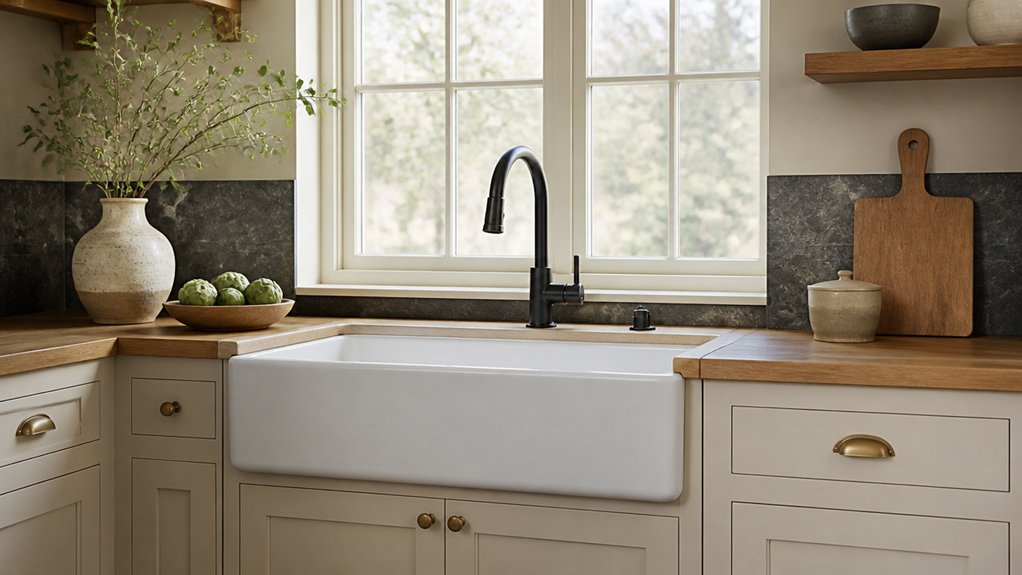
Once your hardware sets the tone, let your sink and faucet carry that same modern rustic balance at the work zone. A deep apron-front sink instantly reads as authentic, but choose crisp edges and a streamlined profile so it feels current, not kitschy.
Fireclay keeps the look classic and resists stains, while stainless offers an industrial-leaning twist that still plays nicely with warm woods.
Pair it with a clean-lined faucet in matte black, brushed nickel, or unlacquered brass, and skip fussy scrolls. A high arc and pull-down sprayer boost function, while a single lever keeps the silhouette minimal.
Tie everything together by echoing finishes across your Farmhouse fixtures and letting rustic lighting cast a soft glow on the basin area.
Mix Open Shelving With Uppers (So It’s Not Dusty)
Even if you love the airy, modern-rustic look of open shelving, you’ll get the best results by balancing it with a run of uppers. Use closed cabinets for everyday plastics, pantry goods, and anything you don’t want on display, then reserve a few open spans for your prettiest, most-used pieces. That mix keeps the room light while making dust prevention realistic.
For shelf styling, think in tight, edited groupings: stack plates, corral mugs on a tray, and lean a cutting board for height. Keep frequently washed items closest to the cook zone, and avoid fussy decor that never moves.
Add under-shelf lighting so open sections feel intentional, not unfinished. You’ll style once, then maintain with quick wipe-downs.
Add Reclaimed Wood Beams, Shelves, or an Island
If you want modern rustic to feel authentic instead of themed, bring in reclaimed wood through beams, floating shelves, or a statement island. Choose boards with real patina—old nail holes, saw marks, and sun-faded grain—then balance them with clean-lined cabinetry and streamlined hardware.
If your ceiling allows, install rustic beams in a lighter stain to keep the room airy while adding depth overhead. For shelves, mount thick slabs on minimal black brackets so your ceramics and glassware look curated, not cluttered.
Want a bigger move? Wrap your island in reclaimed wood paneling or add a chunky butcher-style top, then pair it with modern stools and matte stone counters. Seal everything for durability and easy wipe-downs.
Choose Flooring Built for Traffic (and Spills)
In a modern rustic kitchen, you’ll want flooring that can handle constant foot traffic and the inevitable spills without losing that grounded, natural look.
Choose durable rustic materials with slip-resistant texture, then prioritize sealed surfaces that won’t soak up stains or moisture.
When you pick easy-clean, low-maintenance options, you keep the space looking effortlessly on-trend while spending less time scrubbing.
Durable, Rustic Materials
When your kitchen sees daily foot traffic, muddy shoes, and the occasional dropped glass, the right rustic flooring keeps the space looking intentional instead of worn out. Choose wide-plank engineered wood for that heritage look with modern stability, or opt for wood-look porcelain tile when you want character without constant worry.
Matte finishes and subtle grain variation feel current, not cabin-heavy, and they hide everyday scuffs gracefully.
Carry that durability through the room with honest materials: butcher-block accents, honed stone counters, and thick ceramic or fireclay sinks that age beautifully.
Then tie it together with rustic textiles—think washable runners and linen café curtains—and durable hardware in iron, aged brass, or blackened steel. You’ll get warmth, patina, and performance in one cohesive, modern rustic mix.
Slip-Resistant, Sealed Surfaces
Because kitchens collect splashes, drips, and greasy footprints faster than any other room, you’ll want slip-resistant flooring that’s also properly sealed so it cleans up easily and stays looking refined. Choose slip resistant flooring with a subtle texture—honed stone, matte porcelain with grip ratings, or wire-brushed engineered wood—so your modern rustic look feels authentic, not overly polished.
In high-traffic lanes between the sink, range, and fridge, prioritize finishes that keep traction even when wet. Pair that underfoot confidence with sealed countertop surfaces, especially if you love porous materials like butcher block or natural stone.
A quality sealant deepens color, adds a soft sheen, and helps your counters resist stains from wine, citrus, and oils while keeping that lived-in warmth.
Easy-Clean, Low-Maintenance Options
Although a modern rustic kitchen leans into natural texture, your flooring still needs to shrug off daily traffic, muddy shoes, and the inevitable pasta-water splash without demanding constant upkeep. Choose easy care materials that mimic wood or stone but clean up fast, like luxury vinyl plank, porcelain tile with a matte finish, or sealed engineered hardwood.
Look for stain resistant surfaces with tight seams and durable topcoats, so tomato sauce and red wine don’t linger. If you love wide-plank looks, pick a wire-brushed, low-sheen finish that hides crumbs and scuffs better than glossy boards.
Skip deep grout lines; opt for larger-format tiles or color-matched grout to reduce scrubbing. Finish with felt pads and washable runners, and you’ll keep the rustic vibe while staying practical day after day.
Fit Modern Appliances Into a Rustic-Forward Plan
Even if you’re leaning hard into reclaimed wood, aged metals, and hand-troweled textures, you can still integrate today’s appliances without breaking the rustic spell. Choose panel-ready fridges and dishwashers so cabinetry carries the visual story.
Then add a range with a matte finish or soft-black enamel to echo iron hardware.
For Smart appliances, prioritize hidden tech: touch controls that disappear when off, app features that streamline cooking, and quiet motors that keep the room feeling calm.
You’ll get sleek integrations by aligning appliance fronts, tightening reveal lines, and using integrated handles or warm brass pulls.
If stainless is nonnegotiable, soften it with a vent hood in plaster or wood, and repeat the metal in faucets and lighting for cohesion.
Decorate the Kitchen Without Clutter
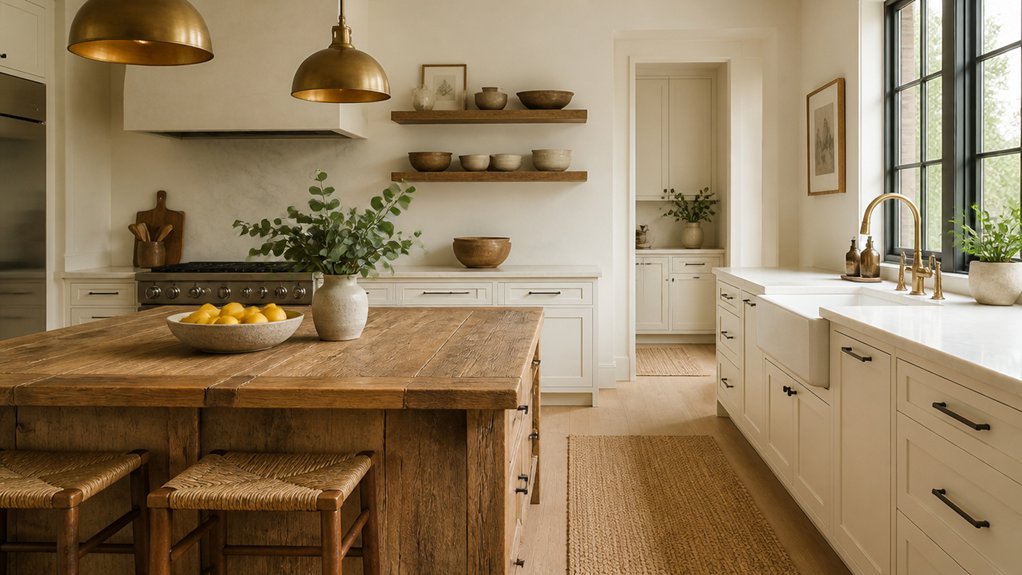
You can keep that modern rustic charm without the visual noise by curating decor that works—think a stoneware crock for utensils or a wooden tray that corrals oils and salt.
Then you’ll lean on hidden storage, like pull-out organizers, drawer dividers, and toe-kick drawers, so everyday tools disappear when you’re done.
Finally, you’ll keep surfaces lightly styled with a few high-impact pieces and plenty of open space to let natural textures breathe.
Curate Functional Decor Pieces
Three thoughtfully chosen pieces can do more for a modern rustic kitchen than a shelf full of knickknacks. Start with one workhorse statement: a thick walnut cutting board you’ll actually use, leaned near the range for warmth and grain.
Add a handcrafted ceramic crock to corral utensils; its matte glaze softens stainless and feels artisan, not busy.
Finish with a single framed print of contemporary art—bold linework or muted abstract—so the room feels current without losing its earthy core.
Keep your accents purposeful: vintage accessories like brass measuring spoons, an enamel bread box, or a patinaed tray can earn their keep while adding history.
Edit by color and material, and leave breathing room on counters so every piece reads intentional.
Maximize Hidden Storage Solutions
A clutter-free modern rustic kitchen starts with one quiet strategy: hide the workhorses where you can still reach them fast. Build hidden storage into every “dead” zone: toe-kick drawers for sheets, a pull-out trash/recycle station, and slim roll-outs beside the range for oils and spices.
For smart space optimization, treat corners like assets—add a lazy Susan or swing-out trays so cast iron and mixers don’t vanish into the void. Choose deep drawers with peg inserts to lock in stacks of plates, and mount a shallow drawer under the sink for sponges and gloves.
If you’ve got open shelving, back it up with closed cabinetry above the fridge or a pantry wall. You’ll keep the rustic warmth without the visual noise.
Keep Surfaces Lightly Styled
Hidden storage handles the heavy lifting behind the scenes, so your counters and shelves can stay calm and intentional. Keep only what you reach for daily: a crock for wooden spoons, a board that leans like art, and one stoneware canister for coffee or salt. Group items in threes and vary height so the look feels curated, not crowded.
Let negative space do the decorating. Swap extra gadgets for Decorative wall accents, like a vintage bread board, a framed botanical print, or a small rail with copper hooks.
Then let statement lighting earn its keep: a blackened-metal pendant or warm-glass sconce adds glow and focus, so you won’t need piles of decor. Edit weekly, and your kitchen stays airy and lived-in.
Modern Rustic Mistakes: Too Themed, Too Dark, Too Busy
Even if you love the cozy cabin vibe, modern rustic kitchens can tip into “theme park” territory fast when you overdo the signs, antlers, mason jars, and distressed everything. Keep decorative accents intentional: one vintage cutting board wall, a single ceramic crock, or a muted landscape print beats a whole collection of quirky quotes. Skip trendy accessories that age poorly and fight your finishes.
Too-dark rooms feel heavy, not hygge. Balance stained wood with warm whites, pale stone, and layered lighting—pendants, under-cabinet strips, and a dimmable ceiling fixture.
Too-busy layouts come from competing textures: knotty wood, patterned tile, open shelving, and chunky hardware all at once. Edit to two main materials, repeat them, and let negative space do the modern work.
Conclusion
You’ve got everything you need to nail a modern rustic kitchen: grounded materials, clean lines, and a few intentional statement pieces. Anchor the space with cabinetry, countertops, and lighting, then layer in a timeless palette and durable flooring that can handle real life. Keep decor edited so the texture—not clutter—does the talking. And remember, it pays to plan: the 2024 Cost vs. Value Report estimates a minor kitchen remodel can recoup about 96% of its cost.