


Start by locking your budget, getting a mortgage Decision in Principle, and checking Bracknell sold prices to set realistic targets. Shortlist areas using commute times, school catchments, council tax bands, and daily amenities. Make a written offer with clear conditions, then instruct a conveyancer early, submit ID and source-of-funds fast, and book the right survey (Level 2 or Level 3). Expect 6–12 weeks, with delays from management packs, enquiries, or lenders—keep documents moving to stay on track. Next, you’ll see how to choose areas, negotiate, and avoid conveyancing traps.
Key Takeaways
- Secure a mortgage agreement in principle, set your maximum price, and budget for deposit, fees, surveys, and Stamp Duty before viewing.
- Compare Bracknell neighbourhoods by commute links, school catchments, amenities, and council tax, using recent sold prices and days-on-market.
- Make a written offer with conditions and timescales, and avoid booking removals or giving notice until exchange of contracts.
- Start conveyancing early: provide ID and source-of-funds immediately, order searches, and respond to solicitor enquiries the same day.
- For leaseholds, verify ground rent, service charges, major works, restrictions, and building safety compliance, and arrange buildings insurance from exchange if required.
Buying in Bracknell: The Steps in Order
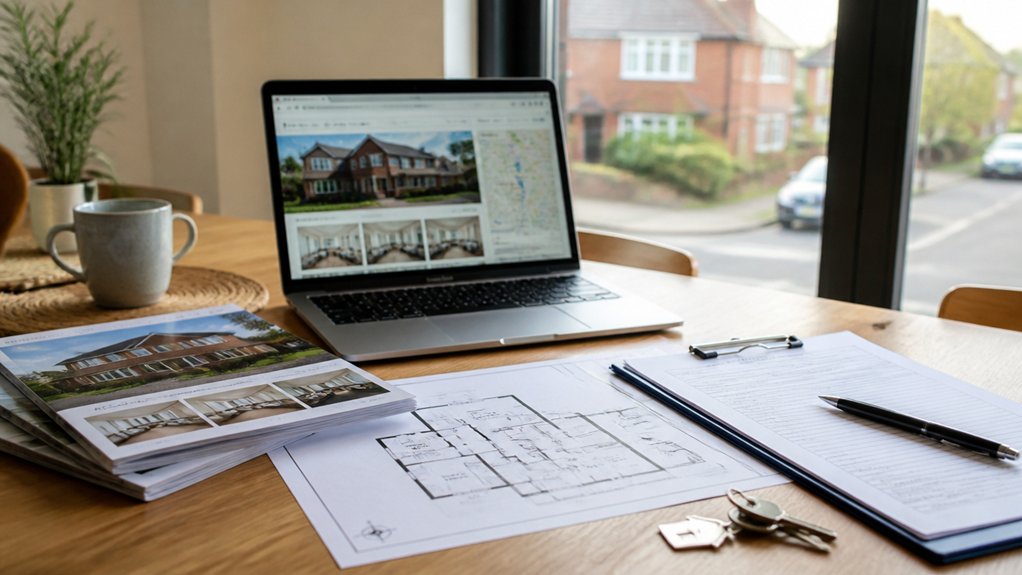
Where do you start when you’re buying a home in Bracknell? First, confirm your budget and obtain a mortgage agreement in principle.
Next, define requirements and instruct a regulated agent to book viewings.
When you choose a property, submit an offer in writing with conditions and timescales.
Appoint a conveyancer and provide ID and source-of-funds evidence to meet AML checks.
Commission a survey, review the title, searches, and replies to enquiries, and confirm buildings insurance for exchange.
Then you’ll exchange contracts, pay the deposit, and set a completion date.
Before completion, transfer cleared funds and complete final checks.
After completion, register with HM Land Registry.
If it’s property investment, calculate rental yields and document compliance costs.
Is the Bracknell Market Rising or Cooling?
To assess whether Bracknell is rising or cooling, you’ll first verify recent sold prices and current demand against comparable properties.
Next, you’ll check inventory levels and track days-on-market to confirm whether listings are tightening or lingering.
You’ll use these indicators together to set your offer strategy and timelines.
Recent Price And Demand
How quickly is Bracknell shifting right now? You’ll see change most clearly in achieved prices versus asking, and in how often vendors agree to reductions after initial marketing.
Run a market analysis using Land Registry, ONS, and comparable sold prices from the last 3–6 months, then separate results by property type and postcode to avoid averaging errors.
Next, test demand through buyer behaviour signals: frequency of best-and-final offers, proportion of chain-free bids, and mortgage-approval-to-offer conversion.
If offers cluster near valuation and price growth flattens, you’re in a cooling phase; if agreed prices consistently exceed comparable evidence, it’s rising.
Treat both as investment opportunities only after you stress-test affordability, rate sensitivity, and rental yield against realistic void and maintenance assumptions.
Inventory Levels And Days-on-Market
Achieved prices only tell you what happened at completion; inventory levels and days-on-market show what’s happening now and whether Bracknell is tightening or cooling.
You should run an Inventory analysis by postcode, property type, and price band, then track weekly new listings versus withdrawals and fall-throughs.
If stock rises and listings linger, you’re likely seeing cooling and wider negotiation scope.
If stock contracts and days-on-market drop, expect competition and fewer conditional offers accepted.
Control for Market fluctuations by separating seasonal effects from true demand shifts, and flag repeated price reductions as a lead indicator.
Use agent feeds and portals, but verify “under offer” dates and relists to avoid distorted timelines.
Set your offer strategy to the current median days-on-market, not last quarter’s headlines.
How Much Do You Need to Buy in Bracknell?

Although Bracknell prices shift by postcode and property type, you’ll need a clear budget that covers more than the headline purchase price: your deposit, mortgage arrangement and valuation fees, conveyancing costs, survey fees, and mandatory taxes such as Stamp Duty Land Tax (SDLT).
Start with Market analysis of recent sold prices and lender affordability, then set a maximum purchase price and stress-test rates.
If you’re using a mortgage, plan for a deposit (often 5–20%), plus lender product fees, broker fees, and a valuation shortfall risk.
Budget for conveyancing disbursements, Land Registry fees, and search packs.
Treat surveys as a control step: a Level 2 or Level 3 report can change your offer.
Finally, model Property taxes, including SDLT bands and any second-home surcharge, before you exchange contracts.
Best Bracknell Areas by Commute, Schools, Budget
Start by setting your priority order for commute time, school catchment access, and budget ceiling, then apply it consistently to each neighbourhood you shortlist.
You’ll compare commute-friendly areas by station links and road access.
Verify top school catchments against current admission criteria.
And document the evidence you use.
You’ll then filter for budget-smart picks by checking recent sold prices and ongoing costs so your final options meet your requirements.
Commute-Friendly Neighbourhoods
When you’re buying in Bracknell, you should shortlist neighbourhoods by three criteria you can verify quickly: peak-time commute options (road links, bus routes, and proximity to Bracknell or Martins Heron stations), school catchment performance, and total monthly cost against your budget.
For commute friendly neighborhoods, start with a map-based screen: measure walk time to stations, then check train frequency and first/last services for your work hours.
Next, validate road resilience by testing A329(M) and M4 junction access during your typical departure window, not off-peak.
Review local transportation options by confirming bus routes, real-time tracking, and whether stops have shelters and lighting.
Finally, run a monthly cost model (mortgage, council tax, parking, rail season ticket) and drop areas that don’t meet thresholds.
Top School Catchments
Commute checks narrow your Bracknell shortlist fast, but school catchments usually decide which streets stay on it. Start by mapping your target schools, then pull each school’s admissions policy, oversubscription criteria, and last-offer distance. Don’t rely on estate-agent claims; verify boundaries with the local authority and ask for the school’s tie-break evidence.
Next, compare recent sold prices inside and outside the line, and note whether local amenities (parks, GP access, supermarkets) support day-to-day logistics. Confirm transport routes for drop-off and after-school clubs, not just the morning commute.
Finally, factor property taxes by checking the council tax band for each address and confirming any planned rebanding or exemptions before you bid.
Budget-Smart Area Picks
Although Bracknell’s price tags can swing sharply street by street, you can keep your search budget-smart by ranking areas against three non-negotiables: your door-to-door commute, the specific school catchments you’ll rely on, and your maximum all-in monthly cost (mortgage, service charge/ground rent if applicable, utilities, and council tax).
For rail-led commuting, prioritise homes within a walkable radius of Bracknell or Martins Heron stations; you’ll reduce transport spend and time. If school access drives value, cross-check each address against the latest admissions maps before you offer, not after.
For tighter budgets, compare estates and maisonettes near town-centre local amenities, but verify lease length, service-charge history, and planned works. Finally, model property taxes and council tax bands per postcode, then stress-test rates and maintenance to avoid affordability breaches.
Bracknell Prices: What Your Budget Buys
Three factors usually determine what your budget buys in Bracknell: property type, postcode, and condition.
Start by mapping your price cap to realistic stock: flats and terraces typically sit below semis, while detached homes command premiums.
Postcode matters: closer to Bracknell town centre, rail links, and major employment hubs, you’ll usually pay more per square foot than on outer estates.
Next, quantify condition. A turnkey home prices in updated kitchens, electrics, and EPC performance; a doer-upper may trade price for time, permits, and contingency.
Check legal and ongoing costs early: Property taxes (Council Tax bands) vary by valuation, and service charges apply to many leasehold flats.
Validate neighborhood amenities—schools, parks, shopping, GP access—against your non-negotiables.
Mortgage Choices for Bracknell Buyers (Who They Suit)
Before you view homes or make an offer in Bracknell, match the mortgage product to your purchase type, income profile, and risk tolerance, then get a Decision in Principle to evidence affordability.
Choose a fixed rate if you need payment certainty through your initial term; choose a tracker or discounted variable if you can absorb rate movements and want flexibility.
If you’re self-employed or have multiple income streams, prioritise lenders with manual underwriting and clear documentation requirements, as Mortgage eligibility will depend on verified, sustainable income.
If you’re buying with a small deposit, expect tighter affordability tests and credit-score scrutiny.
Keep the Loan approval process moving by preparing ID, proof of deposit, bank statements, and employment evidence, and by minimising new credit applications during underwriting.
Upfront Buying Costs in Bracknell (Stamp Duty, Fees)
Before you exchange contracts in Bracknell, you’ll need to budget for upfront costs and confirm what’s due at each stage.
You should calculate Stamp Duty against the current thresholds, then obtain written quotes for conveyancing and other legal fees so your completion statement matches.
You’ll also need to schedule and pay for surveys and any mortgage-related costs (valuation, arrangement, broker fees) to keep your purchase on track.
Stamp Duty Thresholds
Although your solicitor will handle the filing, you still need to budget for Stamp Duty Land Tax (SDLT) at exchange and completion because it’s one of the largest upfront costs when buying in Bracknell.
SDLT is calculated in bands, so you pay different rates on portions of the price once you cross each threshold. Confirm whether you qualify for first-time buyer relief, and check if any higher-rate surcharge applies if you’ll own more than one home.
Treat these as core tax implications: a small price change around a threshold can materially alter your cash required at completion. Build SDLT into your funds-on-completion schedule and keep evidence of the purchase price and intended use.
Don’t offset SDLT by reducing property insurance cover or excess.
Conveyancing And Legal Fees
Once you’ve budgeted for SDLT, you need to ring-fence funds for conveyancing and legal fees, which you’ll start paying from instruction through to completion. You’ll typically pay a solicitor’s base fee plus disbursements, so request a written quote that itemises fee structures and confirms what’s included.
Expect charges for ID checks, searches, Land Registry fees, bank transfer (CHAPS) fees, and file storage or admin. If the title has Legal complexities—leasehold terms, management packs, restrictive covenants, or unregistered land—you should budget for additional work and time.
Control cost and risk by agreeing a fixed-fee scope, confirming whether fees remain payable if the matter aborts, and keeping written approval for any extra work. Keep all invoices and receipts for audit trails.
Surveys And Mortgage Costs
While you’re arranging your mortgage and lining up exchange dates, set aside cash for surveys and lender charges, because you’ll pay many of these upfront and they can’t usually come from the loan.
Book the right survey for the property type: a valuation may satisfy the lender, but you should commission a HomeBuyer Report or Building Survey to manage defects risk and renegotiate if needed. Confirm surveyor credentials, access dates, and report turnaround in writing.
On the mortgage side, budget for arrangement, valuation, booking, and broker fees, plus any telegraphic transfer charges. Check whether fees are refundable, added to the loan, or payable at application.
Lenders may require home insurance from exchange; have proof ready. Model ongoing affordability including property taxes and insurance premiums.
How to Shortlist Bracknell Homes Fast
How quickly can you narrow Bracknell listings to the few that truly fit? Start with non-negotiables in writing: maximum price, minimum bedrooms, commute time, and tenure (freehold/leasehold). Apply filters across portals and agent lists, then export a single shortlist spreadsheet.
Next, map priorities to areas: choose proximity to stations, schools, and Historic landmarks if character matters, or target new-build zones if you prefer Luxury apartments. Set exclusion rules: reject listings missing EPC ratings, tenure details, service charge estimates, or clear boundary information. Flag any “guide price” gaps and require confirmation before you proceed.
Finally, run a rapid risk screen: flood zone, lease length, cladding status (if relevant), and planning constraints. Keep only homes that pass every rule.
Bracknell Viewings: What to Check and Ask

Before you book a second viewing in Bracknell, run each property through a consistent checklist and treat the appointment like a verification exercise. Confirm tenure, boundaries, parking rights, and any service charges. Ask for the EPC, boiler age, electrics certification, and any guarantees for windows, roof, or damp treatment.
Test water pressure, heating controls, mobile signal, and broadband options. Check for condensation, cracks, and odours; open cupboards and inspect loft access if permitted.
Treat interior design and property staging as non-evidence: look past furniture scale and lighting tricks. Measure key rooms, note storage, and map plug, radiator, and window positions. Ask about neighbours, noise, and planned works nearby.
Record answers in writing and photograph issues with permission.
Making an Offer in Bracknell (Strategy + Negotiation)
Once you’re ready to move from viewing to commitment, treat your Bracknell offer as a controlled negotiation rather than a gut decision: set a clear target price supported by comparable sold data, define your non-negotiables (chain position, survey tolerance, completion date), and submit the offer in writing with specific conditions (subject to contract, mortgage, and survey) so the agent can’t “interpret” your position.
Confirm your funding status (AIP, deposit source) and your solicitor’s details to strengthen credibility.
Use Offer strategies: anchor slightly below target, state a deadline for response, and limit re-bids unless new facts emerge.
Apply Negotiation tactics: stay factual, reference evidence, and trade only on terms you can control (timing, fixtures, contingencies).
Record every call and follow up by email.
Which Survey to Book in Bracknell?
Although the lender’s valuation may satisfy your mortgage provider, you still need an independent survey to identify defects, quantify repair risk, and protect your offer terms in Bracknell. Choose the survey based on age, construction, and your risk tolerance.
For newer, conventional homes, book an RICS Level 2 Home Survey to flag damp, insulation gaps, and visible movement.
For older, altered, or non-standard properties, book an RICS Level 3 survey to assess structure, roof condition, and likely remedial scope.
Instruct an RICS-regulated surveyor with Bracknell comparables, and request clear photos, severity ratings, and cost ranges.
Don’t let property aesthetics override red flags. Ask the surveyor to note external influences from local amenities, traffic, drainage, and nearby development.
Schedule access before renegotiation deadlines.
Bracknell Conveyancing to Completion: Timelines and Traps
While your offer might look agreed on paper, you won’t exchange or complete in Bracknell until your conveyancer verifies title, orders and reviews searches, raises and resolves enquiries, aligns mortgage conditions, and agrees contract terms with the seller’s solicitor.
Expect 6–12 weeks, but delays follow slow management packs, missing certificates, unregistered land, or lender queries.
You’ll reduce risk by supplying ID, source-of-funds evidence, and mortgage documents immediately, and by answering enquiries the same day.
Don’t book removals until exchange.
If you’re buying leasehold, check ground rent, service charges, and major works, and confirm Building Safety compliance where relevant.
Arrange Property insurance from exchange if the contract requires it.
If you’ll let the property, confirm lender consent and validate projected rental income against letting conditions.
Conclusion
You’ve now got a clear, end-to-end process for buying in Bracknell: set your budget, secure an AIP, shortlist areas, view with a checklist, offer with evidence, book the right survey, and drive conveyancing to completion. Keep every assumption documented, confirm fees and timelines in writing, and escalate issues early. Don’t skip due diligence just to “win” a property—what’s the cost of moving fast but missing a defect? Stay disciplined, and you’ll complete with confidence.