

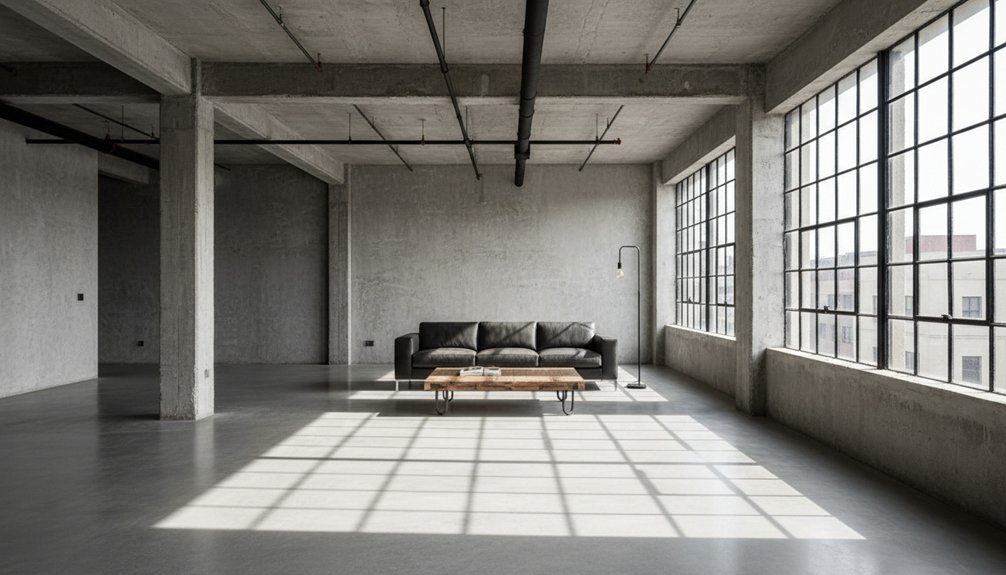
Industrial minimalist interior design keeps your space honest: exposed concrete, brick, steel, ducts, and visible fasteners, but nothing messy. You strip it to essentials, protect open circulation, and hide storage behind flat, pull-less fronts. You run a tight palette of matte white, dirty grey, and soot black, then repeat one accent like rust or olive. You choose workhorse furniture and layer warm 2700–3000K lighting with dimmers. Keep going for the exact moves.
Key Takeaways
- Expose honest structure—concrete, brick, steel, ducts—and keep welds and fasteners intentional, disciplined, and clean.
- Edit aggressively: keep only functional, task-specific objects; standardize forms and repeat details to reduce visual noise.
- Use a tight palette of matte white, dirty grey, and soot black, with one restrained accent color repeated sparingly.
- Choose workhorse furniture with simple silhouettes—steel frames, solid wood, welded tables—using one anchor piece per zone.
- Hide storage and cords: flush, ceiling-height cabinetry with no pulls, concealed channels, and built-ins that preserve open circulation.
Define Industrial Minimalist Interior Design (Key Rules)
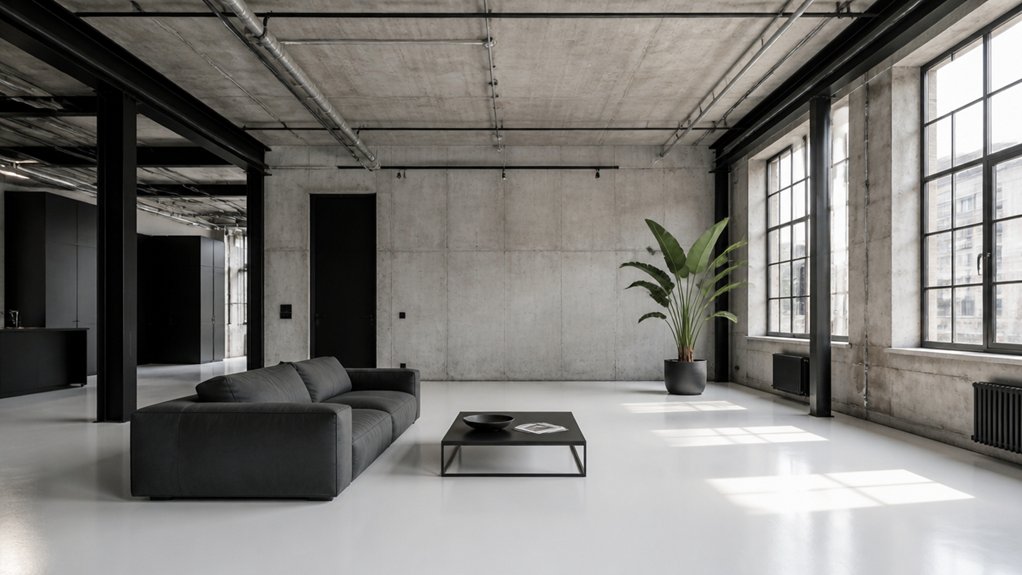
Although it looks stripped down, industrial minimalist interior design follows a tight rule set: keep the structure honest, keep the palette quiet, and keep the space doing work. You expose what’s real—concrete, brick, steel, ducts—then you stop before it turns into décor.
You choose durable surfaces, simple forms, and hardware that feels engineered, not styled.
You borrow from Industrial aesthetic history: factories, warehouses, and utilities built for throughput. Then you apply minimalist design principles: reduce, edit, standardize, and repeat.
You limit objects to essentials, assign every item a task, and remove visual noise. You favor open circulation, clean sightlines, and storage that disappears.
You let wear, welds, and fasteners show, but you keep the room disciplined, not chaotic.
Industrial Minimalist Color Palette That Works
Once you’ve stripped the room to honest materials and hard-working objects, color becomes the control system. Keep the base tight: matte whites, dirty greys, soot black. These tones cut visual noise and let form do the talking. Use Color psychology like a tool: black adds weight and focus, grey steadies the space, white boosts light and clarity.
Then add one restrained accent, not a rainbow. Pick rust, olive, or navy and repeat it twice—textile, art, or a single chair—so it reads intentional. Control sheen: flat on big planes, satin on trim for wipe-down durability.
Lean on paint techniques instead of more stuff: limewash-style variation, dry-brushed edges, or a single darker band to anchor walls without clutter.
Industrial Minimalist Materials: Brick, Concrete, Steel
Why do brick, concrete, and steel feel so right in industrial minimalist rooms? Because they don’t pretend. Brick shows its scars and heat marks; you keep it raw, sealed, and honest.
Concrete lays down a flat, durable skin—floors, counters, even walls—then takes stains, dust, and impact without drama.
Steel brings structure and edge: frames, railings, shelving standards, brackets. You let welds show. You choose matte finishes that kill glare and hide fingerprints.
You pair these surfaces with exposed pipes, not as props but as working lines. You keep Vintage decor tight and purposeful: one factory clock, one salvaged sign.
You balance hard textures with clean light, and you maintain simple maintenance routines.
Less but Better” Industrial Minimalist Furniture Picks
If you keep the palette tough and honest, you’ve gotta keep the furniture tighter. Skip filler pieces and pick workhorse forms: a steel-frame sofa with squared arms, a solid-wood bench that doubles as seating and storage, and a welded coffee table with a slab top. Go low, wide, and stable—nothing delicate, nothing fussy.
Choose one anchor per zone. In the living area, pair one clean sectional with one heavy table; add a single wire chair only if it earns its keep.
In dining, run a long communal table and mix in two ends of Vintage decor, like an old factory stool. Finish with rustic accents: a raw oak sideboard, iron pulls, scuffed leather. You’ll get calm, grit, and function.
Industrial Minimalist Lighting That Feels Warm
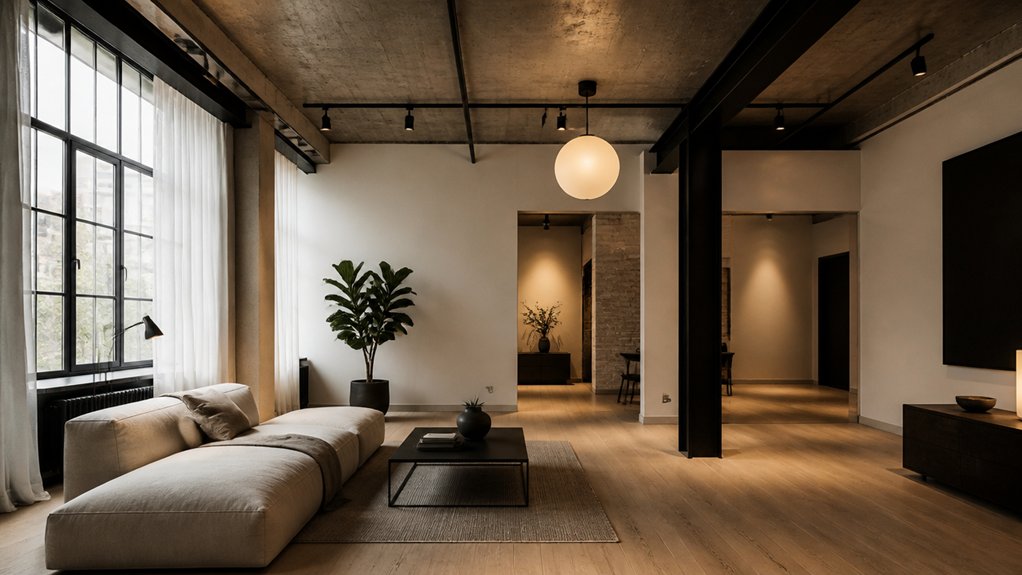
Tight furniture sets the bones, but lighting sets the mood and keeps all that steel and concrete from feeling cold. Start with layers: one hard-working overhead, one task light, and one low glow. Pick LEDs in the 2700K–3000K range so your space reads lived-in, not lab-grade.
Use matte black or brushed metal shades, but aim the beam where you need it. Put a slim rail or track above work zones, then add a floor lamp with a wide diffuser. Soft lighting fixtures like opal globes, linen drums, or frosted tubes cut glare and soften edges.
Add Warm color accents through amber glass, brass interiors, or a single rust-toned shade. Put everything on dimmers. Keep it simple, controlled, warm.
Minimalist Storage That Hides Everyday Clutter
You can’t keep an industrial minimalist space sharp if your daily mess stays out. You hide it with concealed built-in cabinetry, multi-functional storage that disappears inside furniture, and seamless wall-mounted solutions that sit flush and clean.
You keep surfaces bare, lines hard, and everything you use close—just not visible.
Concealed Built-In Cabinetry
Where does the everyday mess go when you want the room to stay brutally clean? You build it into the walls. Concealed built-in cabinetry keeps the industrial shell hard-edged and quiet, with flat fronts, no pulls, and tight reveals. Run cabinets flush to concrete, brick, or steel framing so storage reads like structure, not furniture. Use matte black, charcoal, or raw oak to match the grit.
Inside, you stay strict. Add hidden compartments for keys, tools, remotes, and cleaning supplies so counters stay empty. Plan cable management from the start: grommets, chases, and dedicated bays for routers, chargers, and power strips. Label shelves, size them to your gear, and close the doors. The room stays lean; the clutter disappears.
Multi-Functional Hidden Storage
How do you keep an industrial-minimalist room sharp when life dumps bags, cords, shoes, and paper everywhere? You build storage into the stuff you already use, so clutter never earns a surface. Pick a bench with a lift-top and drop your daily carry inside. Run a bed frame with drawers for off-season gear. Choose a coffee table that splits open for remotes, chargers, and mail. Use ottomans that swallow blankets and tools. Add a console with deep pull-outs for files and cables.
You’re not decorating; you’re containing. Hidden compartments keep the raw lines clean and the floor clear. Space optimization comes from stacking functions: sit, sleep, work, store. When every piece earns double duty, the room stays hard-edged and calm.
Seamless Wall-Mounted Solutions
Two moves keep an industrial-minimalist room tight: get storage off the floor and make it disappear into the wall. Mount cabinets flush, run them to the ceiling, and delete visual breaks. Use slab fronts, push latches, and a matte finish so the wall reads as one plane, not a grid of doors.
Build a recessed rail system for shelves, hooks, and bins you can shift without adding bulk. Hide cords with Hidden wiring channels behind panels and inside uprights; keep outlets aligned and covered.
Wrap media and work zones with Acoustic panels that double as pin-up boards and cable covers. Add a narrow ledge for daily drop items, then close it behind a sliding panel. You’ll keep tools, chargers, and paper out of sight, on the wall, clean.
Conclusion
You strip the room back to rules: clean lines, hard surfaces, zero noise. You keep the palette tight—charcoal, bone, rust—and let brick, concrete, and steel do the talking. You choose less but better: one solid table, one honest chair. You hang warm light low, not bright. You hide the mess behind flat fronts. Then you step back. The space goes still. And in that pause, it finally hits—everything you need is already there.