

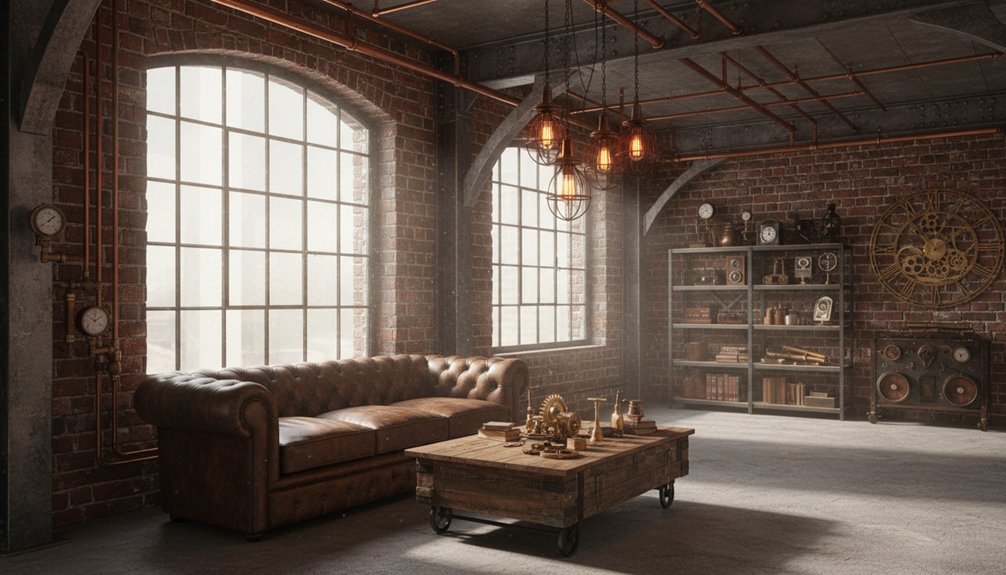
You build an Industrial Steampunk Interior Design room by mixing honest factory bones—exposed steel, rivets, pipe fittings, and scarred reclaimed timber—with warm brass and copper that tarnish under fingerprints and heat halos. You keep the palette in rust, soot gray, and off‑black, then sharpen it with antique gold and bone contrast. You soften the hard edges with scuffed leather, velvet, and tweed. You finish with caged Edison bulbs on dimmers and tight, purposeful vignettes—there’s more ahead.
Key Takeaways
- Mix exposed steel (rivets, bolts, pipes) with reclaimed timber to form the industrial-steampunk foundation.
- Use a warm, aged palette: rust browns, tarnished brass, soot charcoal, and bone accents for contrast.
- Prioritize authentic textures—distressed wood, scuffed leather, pilled wool, and heat-darkened brass or copper patina.
- Layer industrial lighting with Edison bulbs, wire cages, and dimmers to create amber glow, shadows, and metallic highlights.
- Curate purposeful vignettes (gauges, compasses, gears) and integrate shop-style storage to avoid clutter while staying functional.
Define the Industrial‑Steampunk Look (Fast)

If you want a room that looks like it came off a soot-stained factory floor and rolled straight into a Victorian parlor, industrial‑steampunk is your lane: raw metal, aged wood, and honest hardware mixed with brass fittings, rivets, gears, and Edison glow.
You’re blending Industrial motifs—exposed bolts, pipe runs, steel frames, worn concrete—with steampunk aesthetics like burnished copper, clockwork detailing, and cabinet pulls that feel pilfered from an airship.
Keep the vibe utilitarian but theatrical: surfaces show scars, edges stay hard, and finishes skew matte, oxidized, or heat-darkened. You ground it in function-first forms, then lace in era-worn romance: leather, stained oak, smoked glass, and mechanical silhouettes.
The result reads engineered, antique, and slightly dangerous.
Start Here: 5 Must‑Have Style Elements
Whether you’re styling a whole loft or just roughing up a corner, industrial‑steampunk lives or dies by a handful of hard-working details: exposed metal that shows its welds, aged timber with real grain and dents, visible hardware (rivets, bolts, pipe fittings) that looks engineered instead of decorative, warm brass/copper accents that read heat-darkened and handled, and lighting that throws an amber Edison burn through cages, smoke-tinted glass, or factory shades.
Now lock in the mood with five moves: let steel stay raw and scarred, and don’t hide seams. Choose reclaimed wood, oil it, and keep the gouges. Show the fasteners—oversize bolts, flange plates, and valve handles. Add brass and copper where hands would touch: pulls, rails, taps.
Finish with Industrial lighting and one hit of Vintage machinery—gears, gauges, or a flywheel—so it feels built, not themed.
Choose Your Vibe: Workshop, Airship, or Victorian Loft
Before you buy a single pipe fitting or cage light, pick the story your space is going to tell: Workshop, Airship, or Victorian Loft. Your vibe decides every salvage haul, every surface, every prop.
Go Workshop if you want grit and function: workbenches, tool racks, riveted steel, grease-stained ledgers, and practical seating that looks field-tested.
Choose Airship for adventure: brass gauges, nav charts, trunk storage, rope details, and a captain’s desk that feels bolted to the deck.
Pick Victorian Loft for refinement with bite: tufted leather, carved wood, tall bookcases, and factory bones left exposed.
Tie it together with Steampunk fashion cues—belts, goggles, corsetry lines—reimagined as hardware.
Add Industrial art: patent prints, found-object sculptures, and machinist-era signage.
Build a Color Palette (Rust, Brass, Smoke)
Your chosen vibe sets the plot; the color palette sets the patina. Start with rust as your backbone: burnt umber, oxidized red, and dried-blood terracotta that reads like worked iron and long nights. Use Color psychology to keep it intentional—rust feels industrious and warm, never polite.
Layer brass as your highlight: antique gold, tarnished champagne, and muted ochre that catches light like instrument gauges. Keep it controlled, or you’ll slip into glam.
Bring in smoke to steady the room—soot gray, coal, and fogged charcoal for shadows, edges, and depth. Let historical influences guide you: Victorian parlors favored deep, dirty tones; early factories lived in grime and gaslight.
Finish with off-black and bone to sharpen contrast, not brighten.
Pick Materials That Patina Beautifully
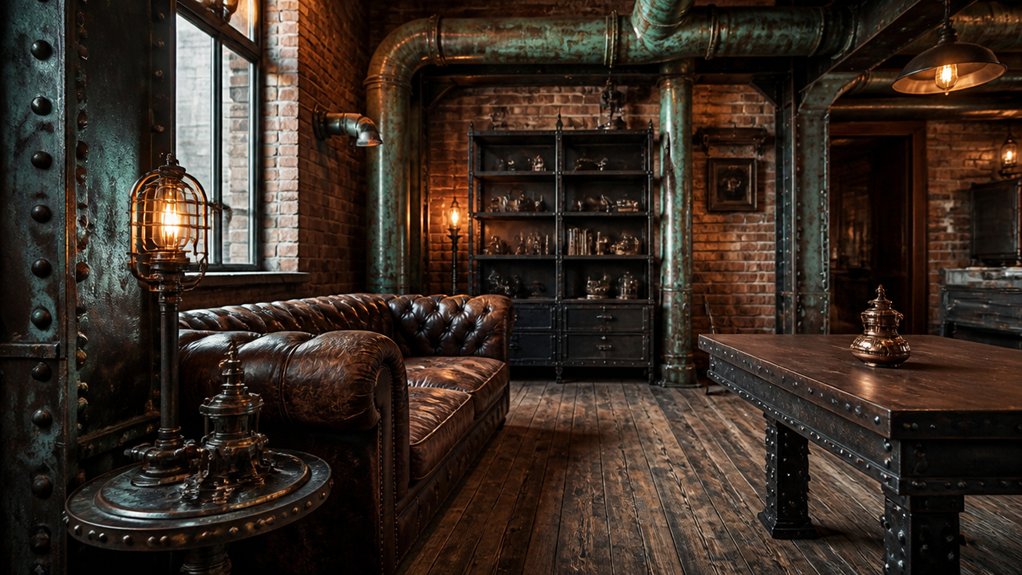
Because steampunk lives and dies on believable wear, choose materials that don’t just survive time—they show it. Start with solid brass, copper, and iron, then let them tarnish instead of sealing them to death. You want fingerprints, heat halos, and darkened corners—a hard-earned Vintage patina, not fake distressing.
Pick reclaimed wood with dents and saw marks, then oil it so the grain stays thirsty and dark. Use leather that scuffs, canvas that fades, and wool that pills a little; they read like gear-bay workwear.
For hardware, choose knurled knobs, rivets, and exposed fasteners that can oxidize naturally. Aim for Weathered finishes on tabletops, trunks, and shelving so every scrape looks like a story, not an accident.
Walls First: Brick, Paneling, and Paint
When you lock in the wall treatment early, the whole steampunk room snaps into focus. Start with exposed brick if you’ve got it; scrub it clean, then seal it matte so soot tones stay put. No brick? Fake it with thin brick veneer and deep mortar lines for that foundry bite.
Add reclaimed wood paneling in narrow boards, stained dark like a ship’s hold, and cap it with iron corner guards.
Paint does the heavy lifting: choose coal gray, oxidized green, or tobacco brown, then distress edges where hands would’ve rubbed. Mount backplates, rivet strips, and gear-shaped trim to echo Vintage machinery.
Position Industrial lighting to rake across texture, making every crack, grain, and brush mark look earned. Keep it rugged, not polished.
Floors + Rugs: Concrete to Worn Wood
Textured walls set the mood; now let the floor carry the weight like a factory deck under heavy boots. Concrete floors give you that foundry-cool backbone—matte, sealed, and slightly mottled, with hairline cracks you don’t rush to hide. Keep edges sharp, then soften the center with worn wood planks: reclaimed oak, scuffed pine, or dark-stained boards that show every knot and nail scar. Mix finishes like a salvage yard ledger—raw, oiled, and burnished.
Anchor your seating with Rug textures that feel workmanlike: flatweave stripes, faded Persian motifs, or jute with a rough hand. Layer one smaller rug over another for grit and depth, and choose muted rust, soot, and tobacco tones. Let every step sound honest.
Add Hardware: Pipes, Rivets, and Brass Details
After you’ve laid that hard-working floor, bolt the room together with hardware that looks like it came off a boiler line. Run exposed pipes along baseboards or up corners, then clamp them with split-ring brackets so they read purposeful, not sloppy.
Add rivet strips on cabinet faces, stair stringers, or wall panels; space them evenly and keep heads proud for shadow and bite. Swap bland switches for knurled toggles, and choose cast-iron outlet plates with visible screws.
Warm it up with brass: valve handles, pipe unions, porthole-style frames, and aged pulls. Mix finishes, but repeat each metal twice so it feels engineered.
These industrial hardware hits turn lights and trim into steampunk accessories fast.
Choose Furniture: Factory Forms, Victorian Curves
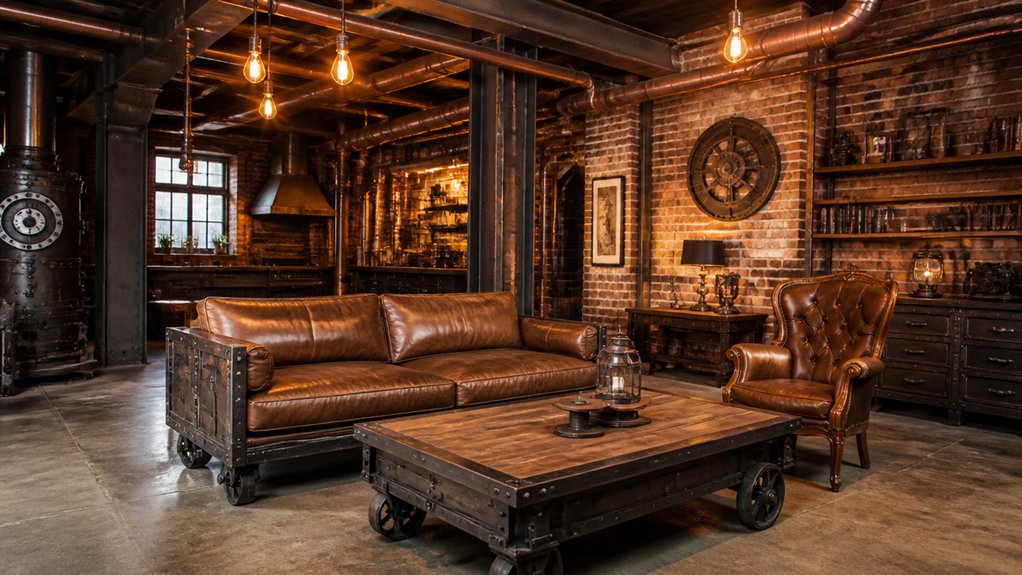
You anchor the room with riveted metal frames and solid woods that look like they’ve clocked a thousand shifts. Then you soften the grit with Victorian tufting and tight, rolled curves—leather worn at the edges, velvet pulled taut.
Finish strong with a salvaged factory statement piece—an old workbench table, a cast-iron locker, a gear-legged chair—so everything feels forged, not bought.
Riveted Metals, Solid Woods
While polished chrome feels too modern for steampunk, riveted steel and dense, honest wood hit the right nerve—hardworking, soot-kissed, built to last. You want furniture that looks hauled from a foundry floor: bolt heads proud, seams visible, corners armored like a boiler plate.
Pick tables with riveted metals for bases and brackets, then top them with solid woods—oak, walnut, reclaimed pine—left slightly scarred, not plastic-smooth. Let grain show through oil and wax; skip glossy lacquer.
Choose chairs and stools with iron frames, wide footrests, and weight you can feel when you drag them across planks. Add a trunk-style bench with metal straps, and you’ll anchor the room in honest, industrial muscle.
Victorian Tufting And Curves
Rivets and raw timber set the backbone, but steampunk still needs a little Victorian swagger in the posture. You bring that attitude in with Victorian tufting: deep buttons, tight pleats, and worn leather that looks like it’s weathered a thousand nights of smoke and gears.
Pick a settee or club chair that sits low and heavy, like it’s bolted to the floor.
Balance the hard lines with curved furniture that softens the workshop edge. Choose rolled arms, camelback silhouettes, and carved legs that feel hand-worked, not delicate.
Keep fabrics dark—oxblood, coal, tarnished brass—and let stitching show. Pair curves with squared frames, so your room reads engineered, but still aristocratic.
Salvaged Factory Statement Pieces
When the room needs a centerpiece that feels forged instead of furnished, pull in a salvaged factory statement piece and let it set the tone. Hunt for a cast-iron workbench turned console, its vise still bolted on, or a riveted steel locker reborn as a bar.
Pair hard factory forms with a sly Victorian curve: a tufted settee beside a drafting table, or a curved-back chair against a brutal pipe-frame shelf. Let reclaimed wood soften the bite—thick planks on a machine base, scarred, oiled, and honest. Keep the patina; don’t sand away history.
Add vintage machinery accents—gear handles, pulley wheels, gauge faces—so every function hints at steam, sweat, and progress. Anchor it with warm, low light.
Soften It Up: Leather, Velvet, and Tweed
You’ve got the iron and oak locked in, so now you soften the hard edges with leather accents that wear their scars—patina, creases, and burnished seams.
You hang velvet drapes and pick velvet upholstery to catch low lamplight, turning soot and steel into something moody and plush.
You finish with tweed—rough, honest texture—layered in throws, cushions, and panels to quiet the room without killing its grit.
Leather Accents And Patina
How do you keep industrial steampunk from feeling like a cold machine room? You bring in Leather accents that look like they’ve ridden through soot and steam. Choose a club chair with cracked hide, a stitched valise used as a side table, or a saddle-leather desktop blotter that warms raw steel.
Let rivets, buckles, and heavy seams echo your pipes and gears, but keep the touch soft and worn. Then chase age with patina finishes. Brush brass with dark wax, rub edges until they flash, and let copper spot and bruise like it’s worked a decade in a boiler shop.
Distress wood with burn marks and oil stains. You’ll get a room that breathes—grimy, handsome, and lived-in.
Velvet Drapes And Upholstery
Where steel and soot threaten to flatten the mood, velvet steps in like a midnight curtain in a back-alley theatre—heavy, hush-soft, and unapologetically lush. You hang velvet drapes to swallow harsh glare off riveted beams and copper pipe, turning windows into moody proscenium arches.
Choose deep oxblood, petrol green, or coal-black; they read like old absinthe bottles under amber bulbs.
For seating, you upholster a tufted settee or wingback in plush fabrics that take a beating yet keep their sheen. Pair it with worn leather and tarnished brass studs so the room stays gritty, not precious.
Velvet’s nap catches light, showing scars and shadows like machinery oil. Treat it as luxury textiles with attitude, not frills. Keep lines tailored, hardware exposed.
Tweed Textures And Layering
A bolt of tweed brings the workshop down to human temperature—nubby, weathered, and built like old rail coats. You drape it over a riveted sofa arm, stitch it onto cushion faces, or slip it under brass-edged trays to hush the clang.
Let Tweed textures sit beside scarred leather and smoky velvet; the mix reads lived-in, not precious.
Use layering techniques like a machinist: base with dark wool, add tweed throws, then cap with a burnished hide pillow. Keep patterns tight—herringbone, salt-and-pepper—so gears, pipes, and Edison bulbs stay the loudest voices.
Finish with frayed hems and saddle-stitch seams, as if the fabric’s survived soot, steam, and late-night tinkering. Add a tweed screen near drafts.
Layer Lighting: Edison, Sconces, Task Lamps
Because steampunk rooms thrive on shadow and shine, you’ve got to layer your lighting like a factory floor after hours—intentional, mechanical, and a little dangerous. Start with Vintage bulbs in wire cages or bare sockets, warm and amber, so brass, leather, and soot-dark wood glow like kiln-fired metal. Hang them low over a table or bar, and let the filaments show.
Next, bolt on Industrial sconces: blackened steel arms, rivets, and swing-joint brackets that throw hard side light across brick and pipes. Aim them to rake texture, not flatten it.
Finish with task lamps—banker shades, articulated drafting lights, or ship’s berth lamps—so you can read, tinker, and sketch blueprints without killing the mood. Dimmer switches keep it controlled.
Decorate With Restraint: Vignettes, Not Clutter
You don’t pile on trinkets—you stage purposeful vignettes, like a brass compass beside a soot-dark ledger on a riveted steel shelf.
You balance rough textures with hard-won breathing room so the patina reads, not the mess.
You edit accessories ruthlessly: if it doesn’t earn its keep in story or function, it’s out.
Curate Purposeful Vignettes
While industrial steampunk begs for gears, gauges, and foundry grit, the room reads sharper when every object earns its keep. Build small scenes that tell one story: a captain’s desk, a machinist’s bench, a signal room corner.
Anchor each vignette with one heavy hitter—Vintage machinery like a cast-iron hand drill, a valve wheel, or a pressure gauge—then support it with two to three tight companions. Keep heights staggered: stacked ledgers, a brass compass, a soot-dark bottle.
Use industrial lighting to spotlight the scene, not the whole room; aim a cage sconce or pivot lamp at the hero object. Repeat metals and patina, label pieces with purpose, and stop before it looks like a salvage bin.
Balance Texture And Space
Even if you crave more brass, more rivets, more soot-black iron, the best industrial steampunk rooms leave hard pockets of breathing space between the grit. You’re not building a junkyard; you’re staging a workshop with intention, where each surface earns its keep.
Work in layers: distressed oak against cold steel, cracked leather beside polished copper—Textural contrast that reads like a well-worn tool belt. Then protect your negative space. Let a brick wall run bare for a beat.
Give your gear-legged console a clear perimeter so its silhouette hits. Keep pathways wide, sightlines long, and lighting aimed to carve depth rather than flatten it. When metal, wood, and stone have room to breathe, you get Spatial harmony—and the room feels engineered, not crowded.
Edit Accessories Ruthlessly
Because industrial steampunk loves a good trophy, accessories can turn a room into a bric-a-brac scrapyard fast—so edit like a foreman with a clipboard. Pick three to five hero pieces per zone: a brass compass, a soot-dark lantern, a cog clock, maybe a framed patent sketch. Everything else earns its keep or gets benched.
Build vignettes with purpose. Anchor them on a tray, a salvaged plank shelf, or a riveted side table so small parts read as one machine, not scattered bolts. Keep negative space around each grouping; it’s your breathing room and your grit. Practice accessories moderation by repeating one metal finish and one leather tone.
For clutter control, hide the extras in trunk storage and rotate seasonal curios. Clean lines stay mean.
Small Space, Small Budget, Fewer Mistakes
If you’re working with a shoebox apartment and a wallet that squeaks, industrial steampunk still fits—you just have to build it like a mechanic, not a collector. Start with one honest anchor: a steel-and-wood shelf, a trunk coffee table, or a riveted headboard. Everything else supports it.
Use Creative storage like a shop floor: wall-mounted pipe rails for jackets, pegboard for tools and keys, crates under the bed, and a rolling cart that doubles as bar and nightstand. Hunt scrapyards, reuse pallets, and buy mismatched hardware; patina forgives.
Choose budget friendly upgrades that fake the forge: aged brass spray on switch plates, Edison bulbs on dimmers, leather straps as pulls, and blackened frames. Measure twice, drill once, and keep floor space breathing.
Industrial Steampunk Interior Design Conclusion
You’ve built an industrial‑steampunk room that feels earned, not staged. Keep the bones honest—steel, brick, rivets—then let brass, rust, and smoke tones settle in like soot on a factory window. Patina beats polish, every time. Soften the grit with worn leather, velvet, and tweed, and stack your lighting: Edison glow, hard‑angled sconces, focused task lamps. Curate tight vignettes, not junk piles, and you’ll keep the story sharp.