

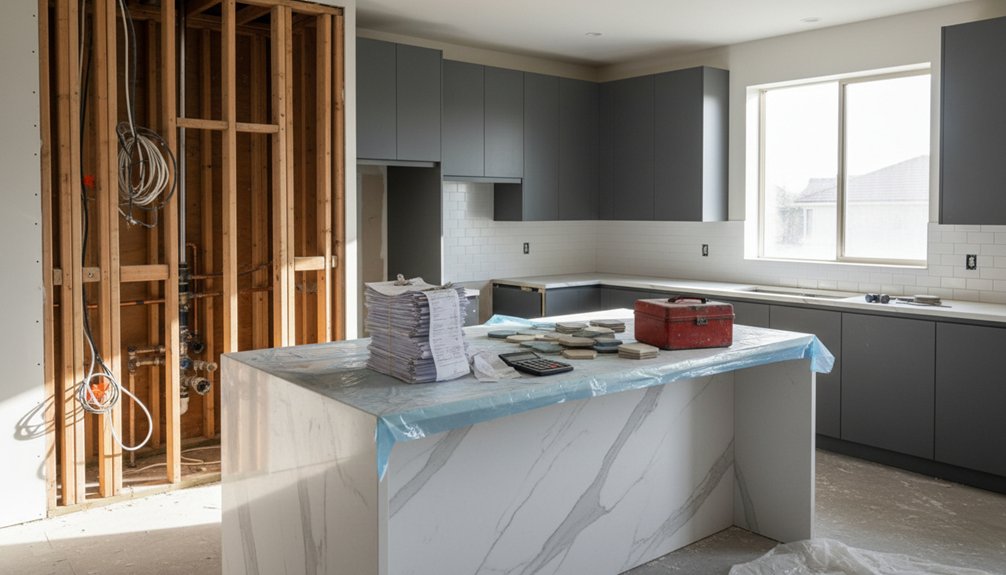
In 2025, you’ll typically spend $15,000–$60,000 on a kitchen renovation, while a full-gut, permit-heavy, code-compliant rebuild often lands at $60,000–$125,000+. You’ll pay more if you move plumbing, gas, or electrical, or touch load-bearing walls. Plan 10%–15% for design/permitting and 10%–15% for contingency. Cabinets (25%–35%) and rough-ins (20%–30%) drive totals, and delivery, demo, and inspections can surprise you—next up is how to forecast them.
Key Takeaways
- Typical 2025 kitchen renovations cost $15,000–$60,000; full-gut, code-compliant remodels often run $60,000–$125,000+ depending on market and finishes.
- Minor refreshes cost $5,000–$20,000, midrange remodels $25,000–$60,000, and upscale overhauls $70,000–$150,000+ with custom work and premium appliances.
- Biggest budget drivers are cabinets (25%–35%), rough-in/code upgrades (20%–30%), and countertops/backsplash (10%–15%), plus a 10%–15% contingency.
- Layout changes and moving plumbing, gas, or electrical systems spike costs due to permits, licensed trades, and potential load-bearing structural work.
- Hidden expenses include demo containment and hauling, delivery/storage fees, temporary kitchen setups, and required upgrades like GFCI/AFCI, circuits, and proper venting.
How Much Does a Kitchen Renovation Cost in 2025?
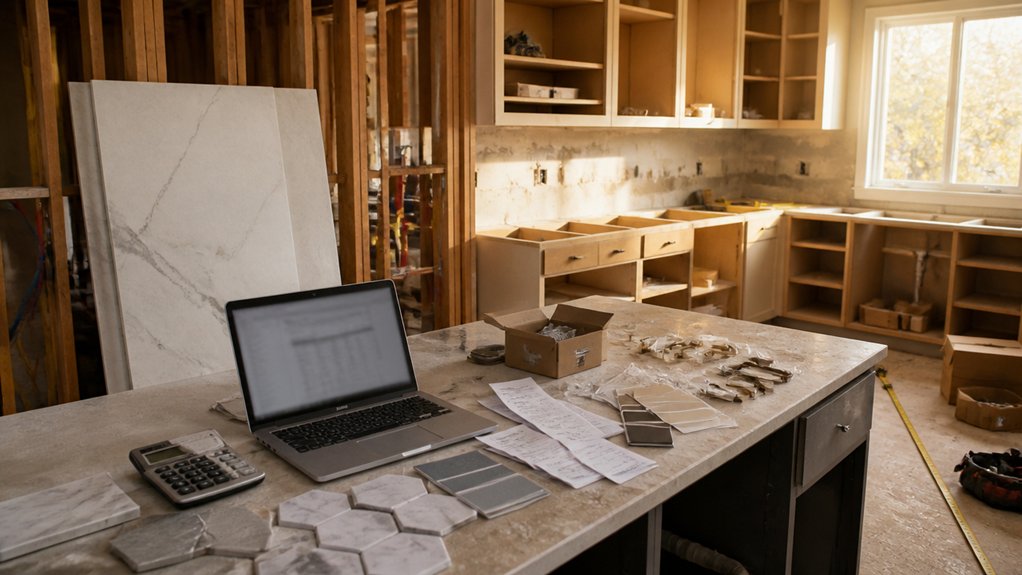
In 2025, most kitchen renovations land between $15,000 and $60,000, with full-gut, code-compliant remodels (new layout, new cabinets, new surfaces, updated electrical and plumbing) often running $60,000 to $125,000+ depending on your market and finish level.
You’ll pay for permits, inspections, and licensed trades, especially if you move gas lines, add circuits, or upgrade ventilation to meet current code.
Material choices swing totals fast: Eco-friendly materials like FSC cabinetry, low-VOC finishes, and recycled-content counters can cost more upfront but may reduce maintenance.
Design trends also affect bids—waterfall edges, integrated appliances, and statement lighting increase labor and electrical scope.
Price your project by confirming drawings, allowances, and contingency before you sign.
Kitchen Remodel Cost Ranges by Scope (Minor to Gut)
Those headline numbers only get useful once you match them to your project’s scope, because a “kitchen remodel” can mean anything from cosmetic upgrades to a full gut that triggers plumbing, electrical, and ventilation compliance.
For a minor refresh ($5k–$20k), you’ll repaint, swap hardware, add LED lighting, and replace a faucet—often no permits, but you still follow GFCI/AFCI and water shutoff rules.
A midrange remodel ($25k–$60k) typically includes semi-custom cabinets, new countertops, code-rated hood or microwave venting, and updated circuits; expect permits and inspections.
An upscale overhaul ($70k–$150k+) adds premium appliances, custom millwork, and built-in fire-safe clearances.
Eco-friendly materials and vintage aesthetics can fit any tier, but verify VOC limits, appliance efficiency, and UL-listed fixtures throughout.
How Layout Changes Raise Kitchen Renovation Costs
When you change a kitchen’s layout—especially the sink, range, or any load‑bearing wall—you don’t just buy new finishes; you pay to move infrastructure. Relocating plumbing means new supply/vent lines, drain slope limits, and wall or slab repairs.
Moving gas or adding a new range location triggers pressure testing, shutoff placement, and permitted work by licensed trades. Electrical shifts add dedicated circuits, AFCI/GFCI protection, and inspection corrections.
If you touch a load‑bearing wall, you’ll need an engineer, temporary shoring, and a properly sized beam, plus patching and paint. Even if you choose Eco friendly materials or lean into vintage aesthetics, layout changes drive labor, permits, and rework—often the biggest cost accelerators.
A Realistic 2025 Kitchen Budget Breakdown (Percentages)
Although every kitchen and permitting jurisdiction differs, you can keep your 2025 renovation financially controlled by assigning clear percentage ranges to each scope line and tracking them against signed bids (not guesses) as code-required items—demo, rough plumbing/electrical, ventilation, inspections, and final connections—often consume more of the budget than the finishes you see.
Plan 10–15% for design/engineering and permit fees, 20–30% for rough-in and code upgrades, 5–10% for HVAC/venting, 25–35% for cabinets and storage solutions, 10–15% for countertops/backsplash, 8–12% for appliances, 4–8% for lighting and electrical trim-out, 2–5% for flooring, 2–4% for paint, and 3–6% for Kitchen decor and punch-list fixes.
Hold 10–15% contingency for concealed conditions.
Labor Costs in 2025: Rates by Trade
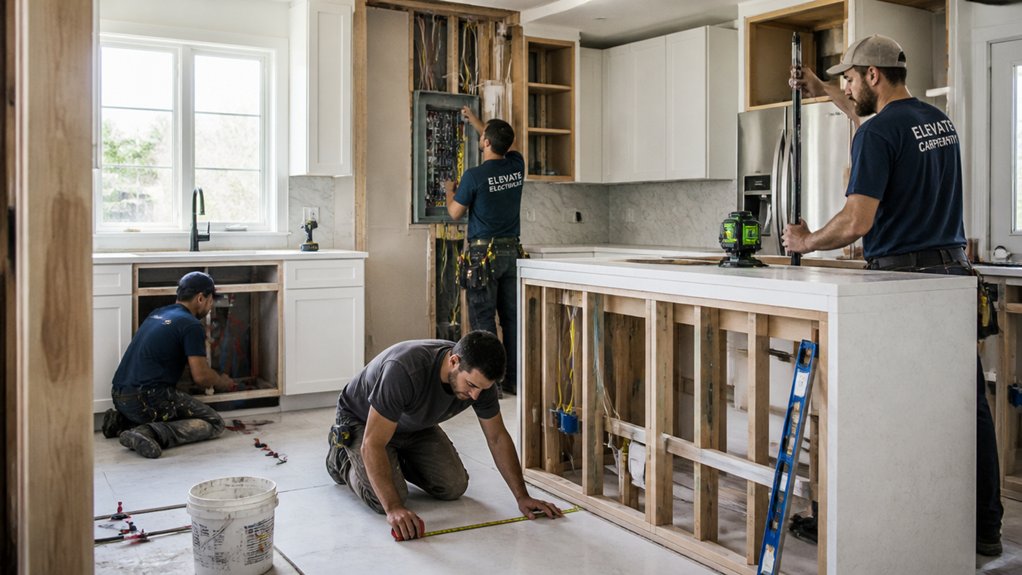
Because labor drives most change orders, you’ll keep your 2025 kitchen renovation on budget by pricing each trade separately and confirming that every quote covers code-required scope—demo and haul-off, licensed rough plumbing/electrical, venting to the exterior, inspections, and final hookups—instead of relying on a single blended “labor” line.
In 2025, expect rough carpentry/GC labor at $75–$130/hr, demo crews $40–$75/hr, licensed electricians $90–$160/hr (more if you’re adding circuits for Kitchen lighting), and plumbers $95–$175/hr.
HVAC/vent specialists often run $85–$150/hr to size ducts and terminate outdoors.
Tile setters typically charge $10–$25/sq ft labor.
Drywall/paint crews price by room or $2–$6/sq ft.
Schedule Appliance maintenance hookups with licensed trades to protect warranties and pass final inspection.
Cabinet Costs: Stock vs Semi-Custom vs Custom
Why do cabinets dominate so many 2025 kitchen renovation budgets? You’re paying for box construction, finish quality, and installation precision that must meet clearances and anchoring requirements.
Stock cabinets cost least and ship fast, but you’re limited in Cabinet styles, sizes, and hardware upgrades; fillers and panels add hidden dollars.
Semi-custom raises price, yet you gain more widths, depths, and organizational options, so you waste less space and reduce labor tweaks.
Custom costs most, but it fits odd walls, integrates appliances cleanly, and can meet accessibility targets without compromises.
Compare plywood boxes vs particleboard, dovetail vs stapled joints, and tested finishes—Material durability cuts replacement risk.
Budget for soft-close hinges, toe-kick ventilation, and code-required anti-tip and wall-fastening hardware.
Countertop Costs by Material (Quartz, Granite, Porcelain)
Next, you’ll price countertops by material, because quartz, granite, and porcelain can shift your 2025 kitchen budget by thousands once you add templating, cutouts, edge profiles, and installation.
You’ll weigh quartz pricing against its consistent look and low upkeep, then track granite cost factors like slab grade, thickness, and sealing requirements.
You’ll also compare porcelain slab price ranges, factoring in fabrication complexity and code-compliant support details for spans, overhangs, and heat exposure.
Quartz Pricing And Value
In 2025, countertop pricing often comes down to one question: what material delivers the best cost-to-lifespan value for your kitchen? Quartz typically lands mid-to-high in price, but you’re buying consistency, low porosity, and reliable warranties that help you predict long-term spend.
Installed cost rises with edge profiles, thick builds, cutouts, and seam placement, so you’ll want itemized bids that separate slab, fabrication, and install labor.
Quartz durability reduces chip and stain risk versus many alternatives, which can lower replacement and repair costs.
Countertop maintenance stays simple: mild soap, no sealing, and heat protection at cooktops.
For code-compliant installs, confirm substrate requirements, overhang support, and sink cutout reinforcement to prevent stress cracks and callbacks.
Plan a 10–15% waste factor for layouts.
Granite Cost Factors
Granite pricing can shift fast depending on the stone you pick and the labor your layout demands. Common colors and 2cm slabs cost less; exotic veining, thicker 3cm, or leathered finishes raise both material and fabrication.
Expect higher bids if you need long spans, multiple seams, waterfall edges, or tight radii cutouts for undermount sinks and cooktops.
You’ll also pay for code-compliant support: plywood sub-tops where required, proper overhang bracing, and securely mounted sink rails.
Granite durability stays strong, but you should budget for sealing, caulk, and periodic reseal schedules as part of stone maintenance.
Delivery, stairs, and limited access add handling charges, while templating accuracy reduces waste and rework.
Porcelain Slab Price Range
Because porcelain slabs mimic marble and concrete with fewer maintenance demands, their pricing tends to track both the slab’s design grade and the fabrication complexity you’re asking for. Expect installed costs of about $60–$150 per sq. ft., with premium veining, large-format prints, or book-matched layouts pushing higher.
Thin profiles can reduce weight, but you’ll still pay more if your installer must reinforce cabinets, add underlayment, or meet manufacturer span limits for code-compliant support.
Budget for extras that move totals fast: sink and cooktop cutouts ($200–$600 each), edge treatments ($15–$60 per linear ft.), mitered waterfall panels ($500–$2,500), and seam placement.
You’re buying material durability, but you’ll still need skilled handling to avoid cracks.
Appliance Costs in 2025: Induction and Smart Upgrades
Next, you’ll budget for appliances, and in 2025 induction range prices keep trending upward as demand grows and models add higher wattage and better ventilation compatibility.
You’ll also pay extra for smart upgrades—Wi‑Fi modules, app controls, and integrated hubs—and you should confirm they meet electrical load requirements, GFCI/AFCI protection, and manufacturer install specs.
With a clear line-item plan, you can compare induction performance gains against the true installed cost of smart features.
Induction Range Price Trends
Where are induction range prices headed in 2025? You’ll see steady-to-slightly higher MSRP, but wider discounting as more brands compete.
Entry 30-inch models commonly land around $1,200–$2,000, midrange $2,000–$3,500, and pro-style $4,000–$7,000+ depending on output, oven capacity, and trim.
Your installed cost rises fast when electrical work’s required: plan for a 240V, 40–50A dedicated circuit, correct breaker sizing, and a code-compliant receptacle or hardwire connection.
If your panel lacks capacity, budget for load calculations and potential service upgrades.
Don’t forget ventilation and clearances; even with induction, you still need manufacturer-required spacing and permits.
Track these price trends before ordering.
Smart Appliance Upgrade Costs
Three line items drive smart-appliance upgrade costs in 2025: the “connected” price premium, the install requirements, and the network/electrical readiness behind the scenes. You’ll typically pay 10%–30% more for Smart technology features—Wi‑Fi modules, cameras, AI modes, and app support—plus longer warranties.
Next, budget labor for appliance integration: pairing hubs, updating firmware, and configuring load management so high-draw devices don’t trip breakers.
Induction ranges may need a dedicated 240V circuit (often 40–50A) and a code-compliant receptacle, box, and disconnect access per local rules.
Finally, plan for readiness: add GFCI/AFCI where required, surge protection, ventilation interlocks, and robust Wi‑Fi (mesh nodes) so the appliances stay reliably connected.
Hidden Kitchen Renovation Costs (Demo, Delivery, Temp Kitchen)
A kitchen remodel budget can look airtight until you account for the “hidden” line items that keep the job safe, legal, and moving on schedule. Demo isn’t just swinging a hammer—you’ll pay for dust containment, debris hauling, dumpster fees, and potential asbestos or lead-safe handling.
If you’re chasing design trends, protect adjacent finishes with floor and doorway barriers, or you’ll fund repairs twice.
Delivery adds real money: lift-gate charges, long-carry fees, storage when cabinets arrive early, and re-delivery if you miss a window. You’ll also need temporary kitchen setups—microwave station, utility sink hookups, and disposable dishware—plus extra electrical cords and lighting.
Choose material durability upfront so you don’t eat change-order costs when fragile surfaces chip during staging, moves, or installation delays.
Permits, Inspections, and Required Code Upgrades (2025)
Even if you keep the layout intact, permits and inspections can add hundreds to several thousand dollars to your 2025 kitchen renovation once you touch electrical, plumbing, gas, or structural work. Fees vary by city and scope, and you may pay separate plan-review, trade, and reinspection charges. Permitting delays can also increase labor and rental costs if crews must pause or reschedule.
Inspections often trigger required upgrades for code compliance: GFCI/AFCI protection, tamper-resistant outlets, dedicated appliance circuits, proper range-hood ducting, shutoff valves, gas flex connectors, and seismic strapping where required.
If you open walls, you may need to bring wiring, venting, or framing up to current standards, not “grandfathered” conditions. Budget for drawings or engineer stamps when structural changes or load calculations apply too.
How to Keep Your Kitchen Renovation Budget on Track
Start by setting a realistic baseline budget that includes permit fees, inspection costs, and any code-required upgrades so you’re not surprised mid-build.
Keep your scope tight and document every change order in writing, because small upgrades can quickly compound into big overruns.
Track labor, materials, and allowances weekly against your baseline, and correct course immediately if you see variance.
Set A Realistic Baseline
Before you price cabinets or pick finishes, lock in a realistic baseline budget built on your kitchen’s actual scope and code requirements. Start by documenting square footage, layout, and existing conditions (plumbing lines, electrical capacity, ventilation). Price required permits, inspections, and any upgrades to meet GFCI/AFCI protection, dedicated appliance circuits, and proper range-hood ducting.
Next, separate “must-pay” infrastructure from optional Kitchen decor so you don’t confuse style choices with compliance costs. Get line-item bids that include labor, disposal, and taxes, and confirm product lead times that can trigger storage or temp-kitchen expenses.
Finally, budget for Appliance maintenance and any needed shutoff valves, water hammer arrestors, or gas tests so your totals reflect real, code-ready operation.
Control Scope And Changes
With your baseline budget set around real scope and code requirements, the next way you keep costs predictable is by controlling scope and locking down changes. Finalize the layout, appliance sizes, and electrical plan before you order anything, because moving plumbing, adding circuits, or relocating vents triggers permits, inspections, and change-order labor.
Put every decision into a written spec: cabinet boxes, door style, hardware, tile pattern, paint sheen, and exact models.
Treat Design trends as optional upgrades, not defaults; if you change your mind midstream, you’ll pay for restocking, rework, and schedule delays.
Prioritize Material durability where it affects replacement cycles—countertops, hinges, drawer slides, and flooring.
Require priced alternates in your bid, and approve substitutions only when they meet code and performance targets.
Track Costs Weekly
How do you stop a kitchen remodel budget from drifting once demolition begins? Track costs weekly, not monthly. Set a fixed “cost-to-date” meeting every Friday with your contractor and designer. Reconcile invoices, delivery tickets, and time sheets against your line-item estimate, including permits, inspections, and required code upgrades (GFCI/AFCI, ventilation, fire blocking).
Log every change order the day it’s approved, with labor hours, tax, and lead times. Compare committed costs to remaining contingency and flag overruns early. If cabinets slip, adjust selections before you pay restocking fees; protect Color coordination by approving finish samples once.
Prioritize Material durability where it reduces lifecycle cost: cabinet hardware ratings, floor wear layers, and quartz thickness. Use a shared spreadsheet so totals stay current.
Conclusion
In 2025, your kitchen budget isn’t a single number—it’s a moving target with a price tag. If you change the layout, you’ll watch costs climb like ivy: plumbing, electrical, framing, permits, inspections, and code-driven upgrades stack fast. Keep your plan tight, your scope written, and your allowances realistic. Track labor by trade, confirm appliance specs (induction, smart loads), and price demo, delivery, and a temp kitchen. Measure twice; pay once.