

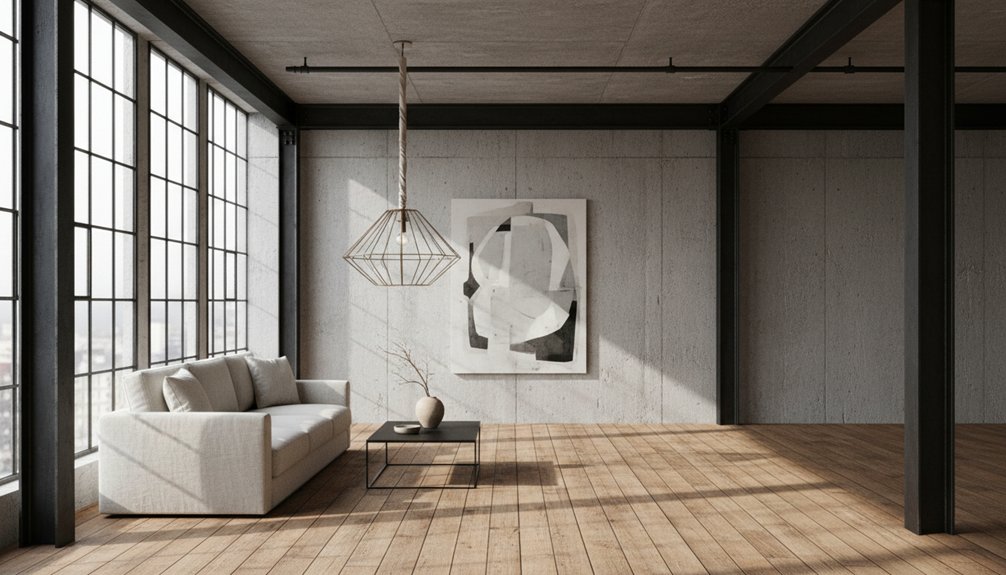
You build minimalist industrial interior design style by stripping back to concrete, steel, brick, and raw wood, then keeping only what earns its space. You lock in a tight palette—black, gray, off-white, rust—and let beams, ducts, and fasteners stay exposed. You balance hard surfaces with texture like oiled wood, worn leather, linen, and ribbed glass. You choose low, lean furniture with clean geometry and open bases. Keep going and you’ll see how to layer light and storage.
Key Takeaways
- Build on raw essentials like concrete, steel, brick, and honest wood, keeping architectural features exposed and unornamented.
- Stick to a tight palette of greys, black, and off-white, using rust, brass, or olive accents sparingly and deliberately repeated.
- Choose low, lean furniture with geometric forms, open bases, and hard edges, softening only with subtle curves and tactile textiles.
- Balance industrial hardness with warmth through matte sealed concrete, worn leather, hand-oiled wood, linen, felt, and ribbed glass.
- Layer lighting and storage using minimal fixtures, dimmers, and industrial cabinets or pipe shelving to keep surfaces clear and clutter hidden.
Minimalist Industrial Style: 5 Defining Rules

If you strip a space down to what it’s made of, minimalist industrial style starts to make sense: you keep the bones—concrete, steel, brick, raw wood—and you cut everything that doesn’t earn its place.
Rule 1: commit to a tight palette—black, grey, off-white, rust—no decorative color drift.
Rule 2: leave structure visible: Exposed brick, beams, ducts, fasteners; don’t hide the build.
Rule 3: choose honest forms—rectangles, cylinders, slabs; skip ornate profiles.
Rule 4: keep furniture low and lean, with clear negative space and hard edges.
Rule 5: light like a workshop: Vintage fixtures, track heads, bare bulbs, metal shades; aim light where work happens.
Then edit again.
Industrial Materials That Still Feel Warm
Although steel, concrete, and brick read cold on paper, they feel warm in real life when you balance their hardness with texture and touch. Let steel show its welds and brushed grain, then soften it with worn leather pulls or a hand-oiled wood top you’ll actually rest on.
Keep concrete honest: matte, sealed, and slightly imperfect, so it catches light without feeling slick. Pair it with a thick wool runner to kill echo and add traction.
Use brick as a heat sink—exposed, repointed, and left uneven—so it reads grounded, not decorative.
Choose raw textures you can feel: linen, felt, hide, ribbed glass. Add cozy elements that earn their place: a solid-wood bench, a heavy throw, a tactile shade.
A Minimalist Industrial Palette (With Examples)
You start with a neutral base—concrete gray, matte black, dirty white—and you lock in contrast with sharp edges and clean breaks.
You let the materials set the tone: rusted steel, aged oak, smoked glass, worn leather.
Then you hit it with controlled accents like brass hardware, a muted olive chair, or a single brick-red textile.
Neutral Foundations And Contrast
Why do minimalist industrial rooms feel so grounded? You start with neutral foundations that behave like structure, not decoration. Use concrete gray, soft white, charcoal, and black as your base, then let each surface earn its place.
Color psychology matters here: grays read steady and honest, whites open the volume, blacks lock the edges and calm visual noise.
Build contrast with value shifts, not extra colors. Put matte walls against satin metal, warm raw wood against cold steel, smooth microcement beside rough brick. That textural contrast keeps the room alive while staying restrained.
Example: white plaster walls, charcoal-framed glazing, a gray concrete floor, and a blackened steel shelf.
Another: pale gray paint, exposed ductwork, and a dark countertop that cuts clean lines.
Material Tones With Accents
Once the neutral base is set, let the materials carry the color and keep accents rare but deliberate. You don’t paint warmth on; you expose it. Let oiled oak read honey, leather read tobacco, and rusted steel read burnt orange. Keep concrete cool and matte so everything else stays honest.
Choose one accent tone and repeat it twice, max: a cognac chair plus a small clay vessel, or a deep green canvas shade plus an enamel tray.
Use textile textures to soften acoustics without adding pattern—wool felt, heavy linen, waxed cotton.
For wall treatments, stay restrained: blackened metal trim, raw plaster, or a single panel of charred wood. Skip glossy finishes; they fake depth and compete with the grain.
Furniture Shapes That Keep It Clean, Not Stark
When the palette runs lean and the finishes stay honest, furniture shape does the heavy lifting. You keep it clean by choosing geometric silhouettes that read clear from across the room: slab-top tables, boxy credenzas, straight-leg seating.
Let steel frames stay thin and exposed, and let wood planes look cut, not carved.
But you stop it from turning stark by working in rounded edges where your body meets the build: a softened sofa arm, a radiused tabletop corner, a curved backrest. You mix one curve per piece, not a whole collection of blobs.
Keep profiles low, bases open, and proportions tight so the floor shows through. Skip fussy tufting and ornate hardware; rely on mass, line, and honest joinery to do the work.
Industrial Lighting Layers for a Softer Mood
You balance ambient, task, and accent light so the steel-and-concrete shell reads calm, not cold.
You soften hard fixtures with diffused bulbs and shaded sources, then add dimmers to throttle the glow from work mode to evening.
You keep the look spare, but you let the light do the layering.
Ambient-Task-Accent Balance
Although industrial interiors lean hard and spare, layered light keeps the materials from feeling cold. Start with ambient: a tight grid of ceiling fixtures that washes concrete, brick, and steel evenly, so shadows don’t swallow edges.
Add task light where work happens—over the island, at the desk, beside the reading chair—aimed low and controlled to cut glare off sealed wood and metal.
Then use accent light to steer attention, not clutter. For Artwork integration, pin a narrow beam to a canvas or print so it reads against raw walls.
For Acoustic considerations, light soft elements—felt panels, heavy drape, a wool rug—so they earn visual weight and you remember to place them.
Balance the three, and the space stays tough, usable, calm.
Diffused Glow With Dimmers
Even if the bones stay steel and concrete, dimmers let the light land softer. You keep the grit, but you control the edge. Run bare bulbs behind wire cages, then knock them down to a low hum. Aim for a diffused glow by adding opal glass globes, frosted tubes, or a simple linen shade that cuts glare without going pretty.
Put dimmer switches on your main ceiling run and your wall-mounted work lights. You’ll shift from hard task light to evening calm without swapping fixtures. Pair warm LEDs with blackened steel, raw oak, and matte paint so reflections don’t bounce.
Keep the layers lean: one overhead line, one focused lamp, one low wash. Clean, adjustable, usable.
Storage Systems to Keep the Grit, Lose Clutter
When exposed steel, concrete, and brick set the tone, storage has to work harder without softening the edge. You don’t hide the industrial language; you build on it with steel lockers, welded pipe shelving, and blackened angle-iron frames.
Anchor the room with Vintage storage—factory cabinets, tool chests, apothecary drawers—then refit them with clean pulls and smooth slides.
For clutter elimination, go vertical and go closed: full-height cabinets, sliding metal doors, and under-bench drawers that swallow cables, paper, and small gear.
Keep open shelves for a few hard objects—cast iron, glass, raw wood—and box the rest in labeled bins. Use one finish family: matte black, galvanized, or oiled oak.
If it doesn’t earn its space, it goes.
Conclusion
You don’t need more stuff—you need better materials and tighter rules. Keep steel, concrete, and blackened hardware, but warm them with wood grain, leather, and matte finishes. Layer lighting so the room works, not just looks tough. Lock clutter behind closed storage and let negative space do the heavy lifting. Here’s the kicker: the average home holds about 300,000 items—cut that down, and the industrial grit finally reads intentional.