

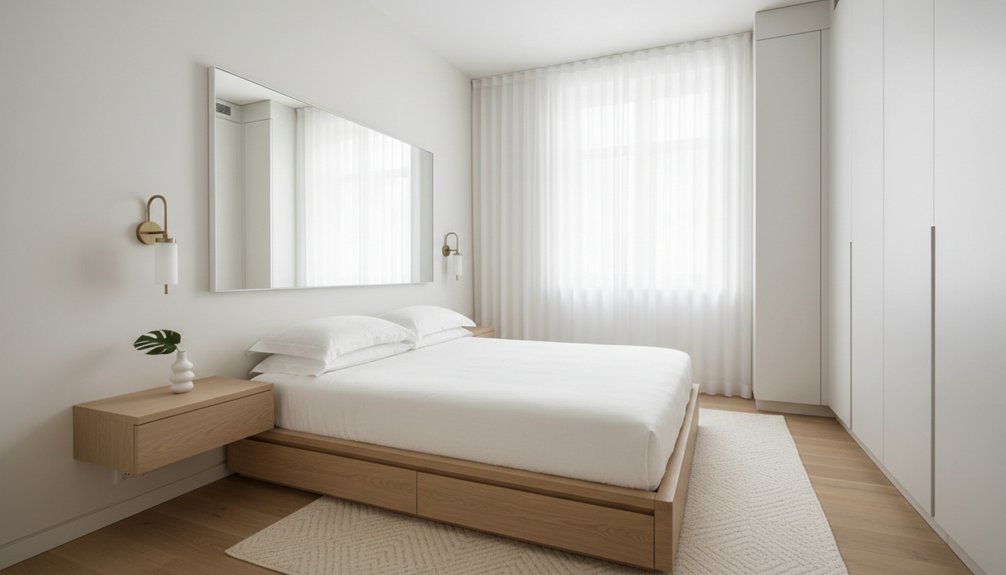
Make your bedroom feel bigger by painting walls soft white, warm greige, or pale sand, and keep the ceiling a half-shade lighter. Choose crisp solids or low-contrast bedding, then ground the space with one deeper piece like a charcoal headboard. Hang a large mirror opposite the window to bounce daylight. Center the bed with clear walkways, pick slim, leggy furniture, add wall shelving, and layer light-filtering curtains with task lighting. Next, fine-tune each detail for maximum lift.
Key Takeaways
- Paint walls in light neutrals and keep the ceiling slightly lighter to reflect daylight and visually lift the room.
- Use crisp, low-contrast bedding and repeat light tones in curtains and rugs to reduce visual clutter.
- Place a large mirror opposite a window to bounce light and create the illusion of more depth.
- Optimize layout with a clear door-to-bed path, centered bed placement, and balanced clearance on both sides.
- Choose right-scale, legged furniture and add wall storage plus layered lighting to free floor space and brighten corners.
Use Light Colors to Make a Small Bedroom Look Bigger
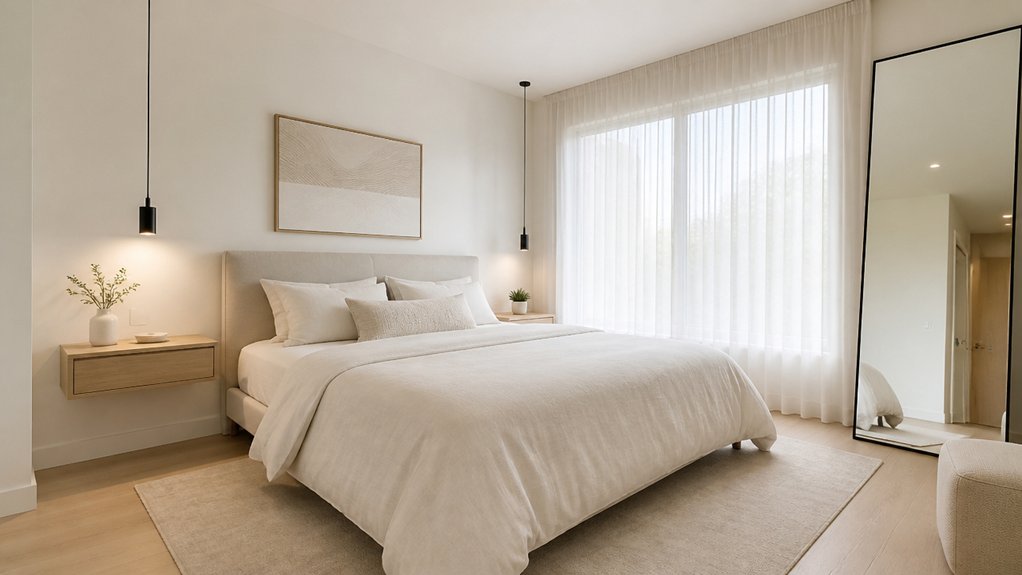
If your bedroom feels tight, start by shifting your palette toward light, airy tones that reflect more daylight and visually push the walls back. Paint walls in soft white, warm greige, or pale sand, then keep the ceiling a half-shade lighter to lift it visually.
Choose bedding in crisp solids or low-contrast patterns so the eye travels without stopping. Maintain color contrast by grounding the room with one deeper element—like a charcoal headboard or walnut nightstand—so the space still feels designed, not washed out.
Repeat your light base on curtains, rugs, and large furniture fronts to reduce visual clutter. Finish with restrained decorative accents: brushed brass pulls, a slim black frame, or a muted throw that adds texture without darkening the room.
Add Mirrors to Bounce Light and Double Space
Because mirrors reflect both light and sightlines, they’re one of the fastest ways to make a small bedroom feel brighter and twice as deep. Place a large mirror opposite a window to throw daylight across the room and reduce harsh shadows. If you can’t fit one big piece, group two or three matching panels for the same effect.
Lean a full-length mirror to create a casual, boutique look, or mount it to keep floors clear. To emphasize ceiling height, choose a tall, vertical mirror or hang it so the top sits near the crown line.
Swap bulky art for mirrors as decorative wall accents, especially above a dresser. Pick thin frames in brass, oak, or black to echo your hardware and keep edges crisp.
Arrange the Bedroom Layout for Better Flow
Even when your bedroom is short on square footage, a smarter layout can make it feel calm, open, and easy to move through. Start by defining a clear path from the door to the bed, then keep it unobstructed so your eye reads one continuous line.
Anchor the bed on the strongest wall, ideally opposite the entry, and center it if you can for visual balance. Use furniture placement to create breathing room: pull pieces slightly away from corners to reduce a cramped look, and align edges so they read as a clean grid.
Leave matching clearance on both sides of the bed for symmetry. Boost perceived space with color contrast—lighter walls behind larger pieces, darker accents kept tight and low.
Pick Right-Scale, Space-Saving Bedroom Furniture
When you match furniture scale to your room, the whole space instantly reads larger and more intentional.
Start with Furniture proportions: choose a bed with a slimmer frame, low-profile headboard, and legs that lift it off the floor so you can see more negative space. Swap chunky nightstands for narrow tables or wall-hugging designs with a single drawer, and keep their height close to your mattress for a clean line.
Pick a dresser that’s long and low rather than tall and deep, so it doesn’t crowd your sightlines.
Use Color contrast strategically: pair light upholstery with a slightly deeper rug or wood tone to define edges without visually shrinking the room.
Avoid oversized armchairs.
Add Wall and Over-Bed Storage (Not Bulky Dressers)
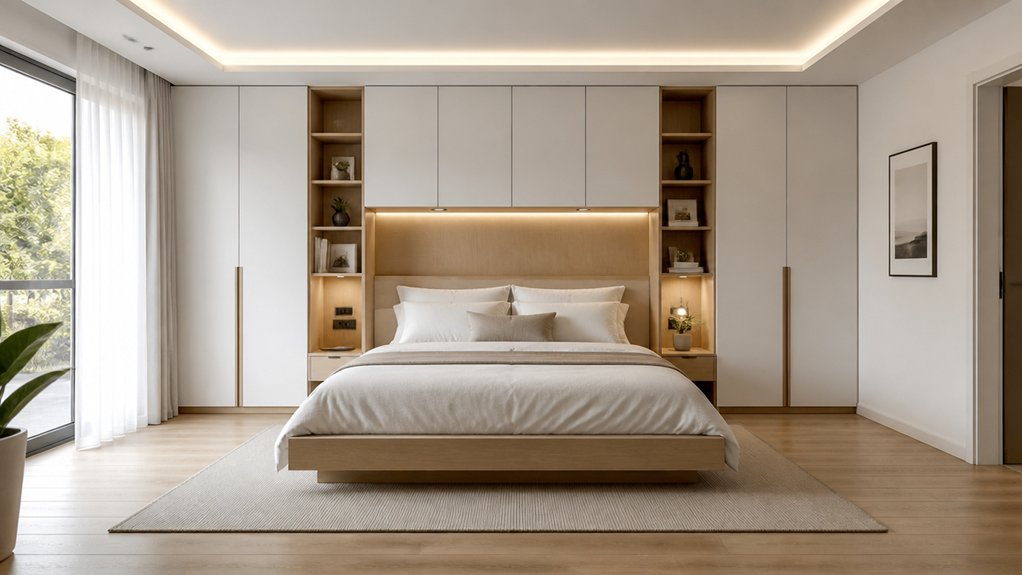
Right-size furniture sets a clean foundation, but you’ll gain the most breathing room by moving storage up the walls instead of out into the floor. Swap a wide dresser for wall shelving that holds folded tees, baskets, and books while keeping walkways clear. Mount shelves 12–18 inches above your nightstand height so essentials stay reachable without crowding the visual plane.
For over bed storage, choose a shallow bridge cabinet or a row of sturdy shelves that spans the headboard, stopping 6–8 inches short of the ceiling for a lighter look. Use matching boxes to hide clutter and keep colors close to your wall paint so edges disappear. Anchor it all with hidden brackets and consistent spacing.
Layer Lighting and Window Treatments to Open Up the Room
You’ll make your bedroom feel bigger by layering lighting: start with soft ambient overhead or flush-mount light, then add focused task lamps at the bed or desk to keep corners bright.
Choose slim fixtures and warm, consistent bulbs so the light reads even and the room feels continuous.
Then maximize natural light by keeping window treatments light and streamlined—sheers or light-filtering shades mounted high and wide let daylight flow and visually stretch the walls.
Mix Ambient, Task Lighting
Although square footage stays the same, layered lighting can make your bedroom read larger by reducing shadows and directing attention where you want it.
Start with an even ambient glow from a flush-mount, semi-flush, or discreet ceiling track, and choose warm LEDs (2700–3000K) for a calm look.
Add task illumination where you need precision—swing-arm sconces at the headboard, a focused desk lamp, or an under-shelf strip—so the room feels functional without extra fixtures cluttering surfaces.
Put each layer on separate dimmers to shift the mood and keep corners bright.
Use light-colored, translucent shades on lamps to diffuse harsh hotspots, and aim beams toward walls or ceilings to visually push boundaries outward.
Keep cords hidden for cleaner sightlines.
Maximize Natural Light Flow
When daylight moves freely through the room, the walls feel like they step back and the ceiling reads higher.
Start by clearing the glass: skip heavy valances, and hang curtains wide and high so the window looks larger even when they’re closed. Choose light-filtering linen or sheer panels, or top-down/bottom-up shades that keep privacy while letting sun wash the upper wall.
Add a mirror opposite or adjacent to the window to bounce light deeper.
Keep sills simple; cluster indoor plants to one side so leaves don’t block the view, and pick pale planters to reflect brightness.
At night, layer warm LEDs in cove details or slim fixtures that echo your ceiling designs without adding visual weight.
Conclusion
When your bedroom’s feeling a little cozy, you don’t need a full overhaul—you just need smarter moves. Keep walls and bedding light to let the room breathe, and hang a mirror where it can quietly borrow daylight. Float the bed for easier flow, choose slim, right-scale pieces, and tuck storage up on walls instead of heavy dressers. Finish with layered lighting and airy window treatments, and you’ll give your space a gentler, more generous footprint.