

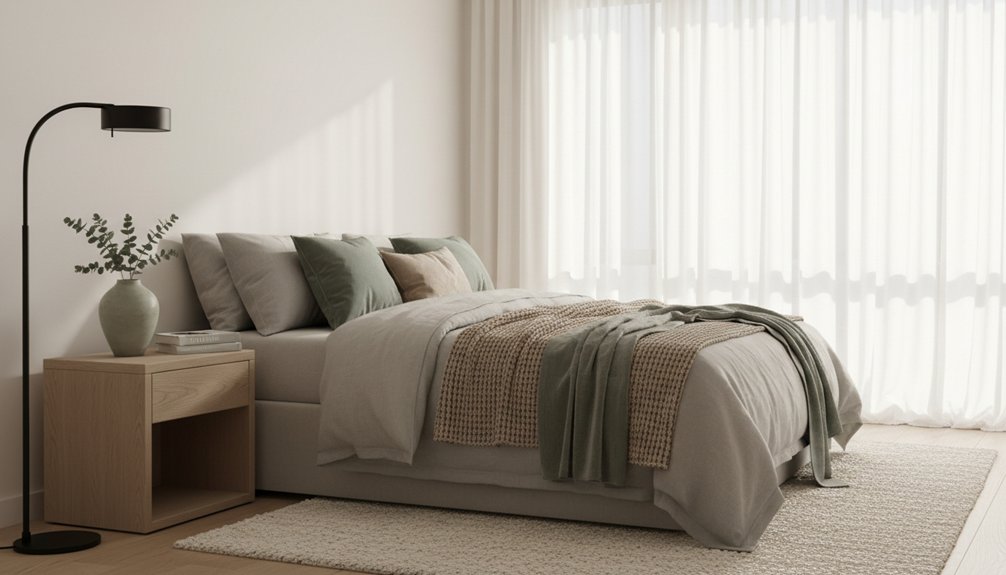
Bedroom colour schemes that always work start with your light: south-facing rooms can handle cooler greige or taupe, while north-facing spaces need warmer, lighter neutrals. Test undertones beside white trim and under night lamps to avoid LED skew, and keep the ceiling a step lighter for lift. For sleep, choose muted blue, sage, or dusty blush in matte or eggshell. Want depth? Pair navy or charcoal with crisp ivory and minimal patterning—next, you’ll see how to build each look beautifully.
Key Takeaways
- Start with room light: south-facing rooms suit cooler tones; north-facing rooms need warmer, lighter bases.
- Choose adaptable neutrals like greige, taupe, or warm off-white, and keep ceilings a shade lighter than walls.
- For restful sleep, use muted warm blues, sages, or dusty blush, balanced with soft neutrals and low-contrast patterns.
- Create timeless contrast with navy or charcoal paired with crisp white or ivory, using minimal patterns and layered lighting.
- Build a nature palette with sage, sand, and clay accents, then add small sky-blue notes and tactile textures like linen and wool.
How to Choose Bedroom Colour Schemes (Light, Undertones, Finishes)

While you might be tempted to start with a favourite colour, you’ll get a more polished bedroom scheme by first deciding how much light the room receives, then choosing the right undertones, and finally matching the finish to the mood and wear.
In bright, south-facing rooms, you can handle cooler hues without them turning icy; in dim, north-facing spaces, you’ll want warmer bases to prevent a flat cast.
Check undertones by sampling beside white trim and at night under lamps, since LEDs can skew green or pink.
Use Color psychology to steer the feel: blue calms, green restores, terracotta grounds.
Then weigh paint finish options: matte hides wall flaws, eggshell cleans easily, satin resists scuffs on busy walls.
Neutral Bedroom Colour Schemes for Any Room and Style
Because neutrals shift dramatically with light and surrounding finishes, the best neutral bedroom colour schemes start with your room’s exposure and your fixed elements—flooring tone, trim colour, and textiles—then build a layered palette from there.
In a bright room, you can handle deeper greige, taupe, or putty; in a dim room, lean warmer and lighter so the space doesn’t read flat. Keep ceilings a step lighter than walls for lift, and echo trim either crisp white or a softened off-white for continuity.
For Accent wall ideas, use a matte clay-beige behind the headboard, or try vertical painted panels to add architecture without contrast.
Finish with smart bedroom lighting options—warm LEDs, shaded sconces, and dimmers—to keep neutrals polished, not washed out.
Soft Bedroom Colour Schemes for Better Sleep (Blue, Green, Blush)
Three soft colour families—blue, green, and blush—set a calmer tempo in the bedroom when you keep the palette muted, warmed slightly, and consistent from wall to textiles.
Choose powdery blues with creamy undertones to soften morning light, then echo them in chambray bedding and brushed nickel accents for subtle Mood enhancement.
If you prefer green, lean into sage or eucalyptus; pair with warm oak, linen curtains, and a single deep olive cushion to ground the scheme without agitation.
For blush, pick dusty rose over sweet pink, and balance it with bone, putty, and pale terracotta.
Prioritise paint finish selection: matte or eggshell on walls reduces glare, while satin on trim adds clean definition.
Keep patterns small-scale and low-contrast.
Bold, High-Contrast Bedroom Colour Schemes That Add Depth
Soft, muted palettes help your bedroom feel hushed, but high-contrast schemes can add just as much calm—only with sharper definition and more architectural depth. Pair inky navy with crisp white trim, or charcoal walls with warm ivory bedding, and you’ll highlight corners, ceiling lines, and millwork without visual noise.
Use Color psychology to keep it restorative: anchor the room with a darker hue that feels protective, then balance it with light-reflective accents that steady your focus.
For furniture coordination, repeat the contrast in a disciplined rhythm—black bedside tables against pale walls, or a light upholstered headboard against a deep backdrop—then unify with one metal finish and one wood tone.
Keep patterns minimal, scale oversized, and lighting layered.
Nature-Inspired Bedroom Colour Schemes (Sage, Clay, Sand, Sky)
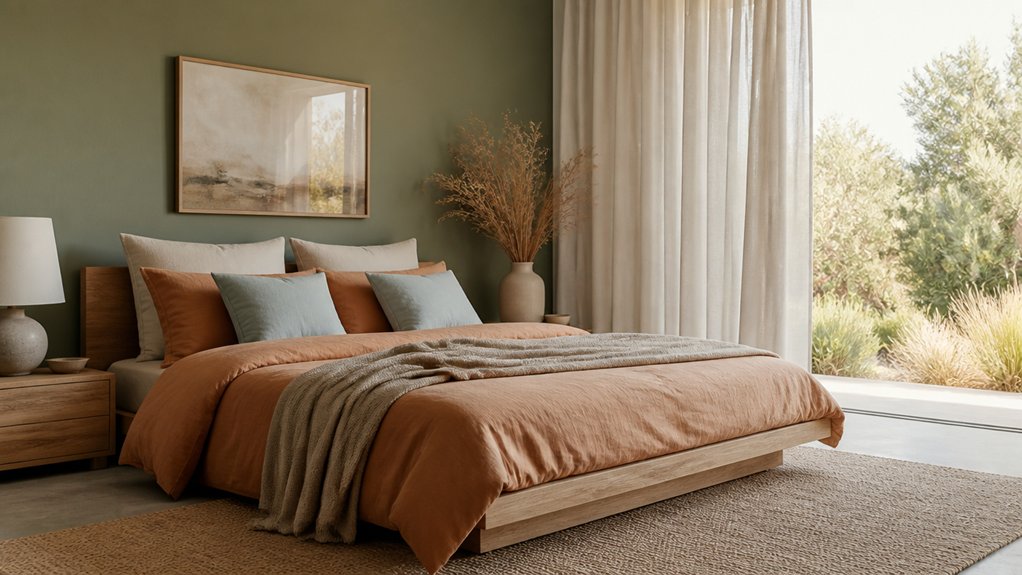
When you want a bedroom that feels grounded without turning flat, nature-inspired colour schemes—sage, clay, sand, and sky—give you a calm baseline with built-in variation. Start with sage walls or bedding to soften light and mute visual noise, then layer clay accents—terracotta lamps, rust cushions, warm artwork—to add quiet heat.
Use sand as your connective neutral: linen curtains, boucle upholstery, pale oak, and woven rugs that keep the room airy. Bring in sky through small, cool notes—powder-blue throws, glass vases, or a matte ceiling—so the palette breathes.
You’ll get soothing colour palettes that still feel nuanced when you mix undertones carefully: olive-leaning greens, pinked clays, and creamy sands. Finish with nature-inspired textures—stone, rattan, wool—so the scheme reads intentional, not themed.
Conclusion
You’ve seen that bedroom colour schemes work best when you balance light, undertones, and finish—then choose neutrals, soft sleep-friendly hues, bold contrast, or nature-led palettes to suit your space. But here’s a theory worth testing: your “best” colour isn’t universal; it’s a measurable mood cue shaped by circadian light. Try living with swatches from morning to lamplight. If the room feels calmer at night, you’ve found your always-work shade.