

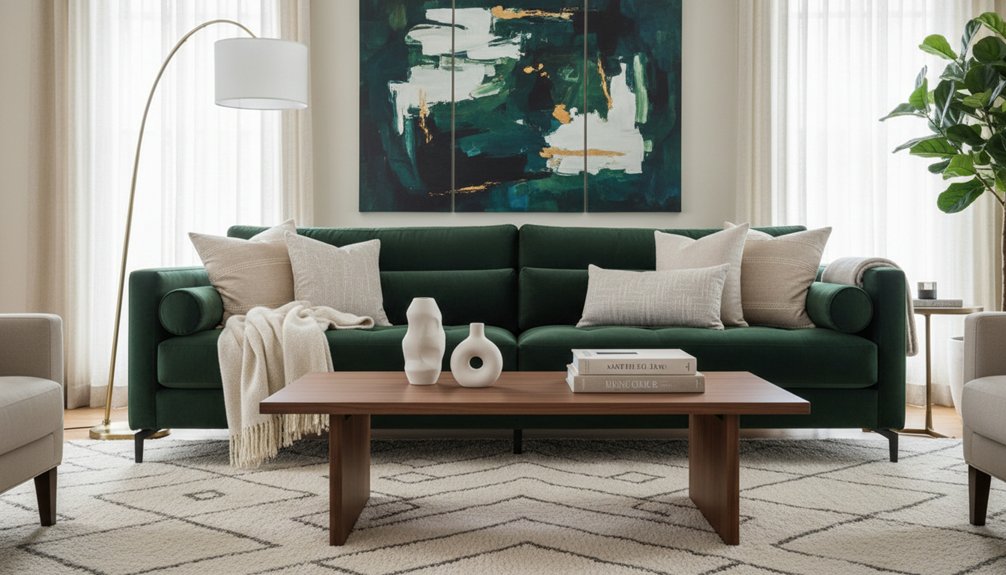
Start by naming your sofa’s “wow” in one phrase (color, shape, fabric, or scale), then place it where it commands attention—floated or slightly off the wall—with clear walkways and no tall pieces behind it. Build a 3–5 color palette from the sofa: 60% neutral, 30% supporting tones, 10% accent, and repeat each shade twice. Add a properly sized rug, layered textures, warm dimmable lighting, and art scaled to the sofa. Keep going for easy layout and styling wins.
Key Takeaways
- Define the sofa’s “wow” feature (color, shape, fabric, or scale) in one phrase to guide every design choice.
- Place the sofa to command attention, leaving breathing room at both ends and keeping tall pieces out of its immediate backdrop.
- Build a cohesive palette from the sofa: 60% neutral, 30% supporting tones, 10% accent, repeating each color at least twice.
- Anchor seating with a properly sized rug under front legs, then layer pillows and throws in three colors with mixed textures.
- Balance the room with scaled lighting and art, and avoid clutter by choosing fewer, larger accessories with intentional negative space.
Decide What Makes Your Sofa the Focal Point
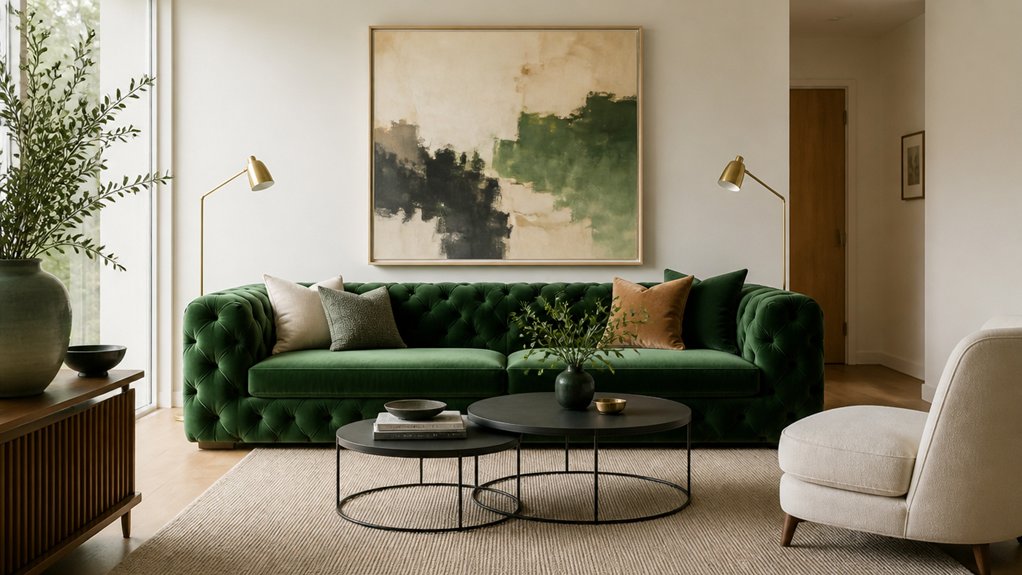
Whether your sofa stands out because of its color, shape, fabric, or scale, you need to name that “wow” factor first and build everything else around it. Step back and describe it in one phrase: “curved velvet,” “sleek tuxedo arms,” or “oversized low profile.” That label guides every decision you make next.
Then, position the sofa so the room naturally looks to it. Float it to define the center, or anchor it on the longest wall to stop visual drift. Protect the statement by controlling sightlines: keep tall pieces out of its immediate backdrop and leave breathing room on both ends.
Let the sofa fabric lead the mood—polished, cozy, tailored—so your seating arrangement supports it with simpler silhouettes and consistent scale. Avoid competing patterns nearby.
Build a 3–5 Color Palette From the Sofa
Once you’ve defined your sofa’s “wow” factor and given it clear sightlines, pull a tight color story from it so everything else feels intentional. Start with the sofa as Color 1, then sample two supporting tones you can spot in its weave, piping, or pattern.
Add one neutral that calms the room—think warm ivory, soft greige, or inky charcoal—so your mix has Color harmony. If you want more energy, introduce a fifth accent in small doses for Palette contrast, like brass, black, or a saturated jewel tone.
Keep the ratio simple: 60% neutral, 30% sofa/supporting colors, 10% accent. Repeat each shade at least twice through pillows, throws, rugs, and art for unity.
Choose Wall Paint That Flatters the Sofa
Start by spotting your sofa’s undertones—warm, cool, or neutral—so the wall color plays in harmony instead of fighting it.
Then balance light and depth: use pale, airy paint to lift a bold shade, or a moodier tone to ground a light fabric.
Before you commit, tape up large paint samples right next to the sofa and check them morning to night under your room’s lighting.
Identify Sofa Undertones
Before you pick up a paint deck, take a close look at your statement sofa’s undertones—the subtle color cast that reads beneath the main hue—because that’s what’ll make your walls feel perfectly “in sync” (or strangely off).
Start by identifying the sofa color in daylight: does it lean warm (yellow, red, rosy) or cool (blue, green, gray)?
Use quick undertone hints: hold a true-white sheet and a warm cream pillow against the upholstery. If the sofa looks cleaner beside white, it likely runs cool; if it looks richer next to cream, it’s probably warm.
Check shadows, too—cool undertones read steely in shade, while warm ones turn golden or terracotta.
Once you’ve named the undertone, choose wall paint with the same temperature for a seamless backdrop.
Balance Light And Depth
Although your sofa sets the mood, the wall color controls how heavy or airy it feels in the room. If your statement sofa is dark or saturated, keep most walls light—soft warm whites, pale greiges, or misty taupes—to lift the silhouette and prevent a cave effect.
If your sofa is pale, add depth with a midtone paint so it doesn’t disappear; think clay, smoky blue, or muted olive. Use an Accent wall only when you want to underline the sofa’s presence: place it behind the sofa and choose a shade one or two steps deeper than the other walls.
Tie it down with Floor accents—wood tones, a rug border, or dark table legs—so the color reads intentional, not floating.
Test Paint Samples Nearby
Once you’ve narrowed your wall color options, tape large paint swatches (or peel-and-stick samples) on the wall right behind and beside the sofa so you can see how the color plays against the upholstery.
For accurate color testing, view them morning, afternoon, and night with lamps on; that velvet or leather shifts undertones fast. Step back to your usual viewing spot, then sit on the sofa to judge how the wall frames it at eye level.
Move the paint samples next to any trim, rug edge, and art you’ll keep, so you catch clashes early. If the sofa is bold, choose a wall shade that echoes one subtle thread in the fabric, not the loudest note.
Photograph each option to compare quickly.
Place the Sofa for Maximum Impact (Layout First)
If your sofa’s the star, you’ve got to give it a stage, so start by deciding where the room’s natural focal point sits—fireplace, picture window, built-ins, or TV—and angle the sofa to face it.
Then pull it off the wall when you can; a few inches of breathing room makes it feel intentional, not shoved in.
Map the main walkway first, and keep it clear so the room flows.
Aim for strong Furniture placement: center the sofa on the focal point, then anchor it with two chairs or a loveseat opposite for balance.
Build Room symmetry with matching side tables or lamps, even if the seating mix is eclectic.
Leave enough space for knees and coffee table reach, and make sure sightlines to the focal point stay open.
Pick the Right Rug Size, Color, and Pattern
With the sofa placed like the lead, let the rug set the frame beneath it—it’s what makes the seating area read as one intentional “room.”
Go bigger than you think: choose a rug that fits at least the front legs of the sofa and any chairs, with 8–12 inches of floor showing around the edges (or more in a large space).
For Rug placement, center the rug on the sofa, not the coffee table, so the conversation zone feels anchored.
Pull color from the sofa—either match a secondary tone or choose a calm neutral to let the upholstery shine.
If the sofa is solid, add a patterned rug for movement; if it’s bold, keep the rug subtle.
For Pattern coordination, repeat one motif at a smaller scale in pillows or art.
Choose Curtains That Frame, Not Fight, the Sofa
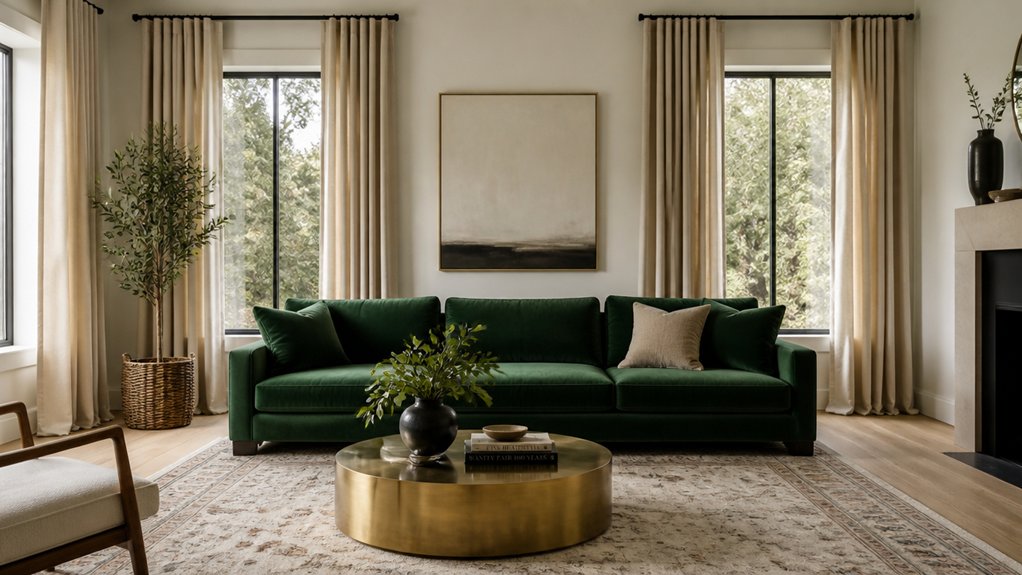
Because your statement sofa already steals the scene, your curtains should act like a tailored frame: clean lines, generous panels, and a tone that supports the upholstery instead of competing with it.
Start by echoing one subtle note from the sofa—its undertone, trim, or a muted accent—and choose Curtain fabric that repeats it quietly in solid, texture, or a low-contrast weave.
Hang rods wider than the window so panels stack off the glass, letting the sofa read uninterrupted. Go long, grazing the floor for polish, or hovering a half inch for crispness.
If your sofa is bold, pick linen blends, sheers, or matte cotton; if it’s quiet, add a softly patterned window treatment.
Keep hardware simple and warm-toned.
Pick a Coffee Table With the Right Scale
Choose a coffee table that matches your sofa’s proportions—long enough to feel connected, but not so big it crowds the seating. Balance the visual weight by pairing a bold, bulky sofa with a lighter table (or grounding a sleek sofa with a sturdier piece).
Keep clear pathways by leaving comfortable space around all sides, so you can walk through and reach the table without squeezing.
Match Sofa Proportions
If your statement sofa reads bold and generous, your coffee table needs to keep pace without crowding it. Start by matching sofa proportions: aim for a table about two-thirds the sofa’s length, so it visually “belongs” in front of it.
Keep height in check, too—choose a surface that sits level with the seat cushion or 1–2 inches lower for easy reach and a clean sightline.
Leave 14–18 inches between the table and sofa edge so you can walk through and still pull up a tray.
For deep, low sofas, pick a wider table or an oval that reaches into the lounging zone.
For petite sofas, go slimmer, or split the footprint with two nesting tables for proportions balance.
Balance Visual Weight
Once you’ve nailed the right length and height, focus on visual weight so the coffee table doesn’t look flimsy next to a statement sofa—or like it’s trying to compete.
If your sofa reads bold and grounded (tufting, thick arms, deep color), choose a table with substance: a chunky slab top, sturdy pedestal, or nested pair that stacks into a solid silhouette.
If the sofa feels airy (slim legs, curved profile), keep the table lighter with open bases, glass, or thin metal lines.
Lock in Color harmony by repeating one sofa tone in the tabletop material or finish—walnut with warm upholstery, black metal with inky velvet.
You’ll get Visual balance when the table’s mass mirrors the sofa’s presence, not its exact shape.
Maintain Clear Pathways
Two measurements keep your living room feeling effortless: the clearance around the coffee table and the reach from the sofa. Aim for 16–18 inches between table and seat so you can stand, pass, and stretch your legs without weaving.
Keep 30–36 inches on main walkways to protect traffic flow from door to seating and from seating to exits.
Pick a coffee table that’s about two‑thirds the sofa’s length and roughly level with the seat cushion (or 1–2 inches lower). If your sofa is bold or oversized, choose an airy base, rounded corners, or a slimmer profile so the room doesn’t feel blocked.
In your furniture arrangement, center the table on the sofa, then align chairs to create a clean, obvious loop.
Add Side Tables That Echo Sofa Materials
Because your sofa already sets the tone, choose side tables that pick up on its key materials so the whole seating zone feels intentionally layered.
If you’ve got a velvet or bouclé statement piece, try a table with a softly honed stone top or a matte lacquer finish that complements those fabric textures without competing.
For a leather sofa, bring in warm wood, smoked oak, or saddle-toned rattan to reinforce material coordination and add depth.
Match one element, not everything: echo the sofa’s leg finish with table bases, or mirror its metal accents with slim brass or blackened steel frames.
Keep scale tight—table height near the seat cushion, top within easy reach—and let the pairing look deliberate, not crowded.
Layer Pillows and Throws With a Simple Rule
Keep your statement sofa looking intentional by sticking to a three-color palette for pillows and throws. You’ll get richness by mixing textures—linen, velvet, knit, or boucle—while keeping pillow sizes consistent for a clean, tailored line.
Finish with one throw that repeats a key color and adds contrast through texture, not bulk.
Stick To Three Colors
When your statement sofa already steals the spotlight, a tight three-color palette makes the rest of the room feel intentional instead of busy. Pick one color from the sofa, add a calm neutral, then choose a single accent that repeats across the space for Color harmony and Mood enhancement.
Use that trio as your shopping filter for pillows and throws: if it doesn’t match two of the three, skip it. Let the neutral anchor the largest pieces, like a throw draped over the arm, then sprinkle the accent in smaller hits, like a single pillow or a slim lumbar.
Repeat the same three colors in nearby details—art, a vase, a rug stripe—so the sofa feels integrated, not isolated. Keep counts balanced for cohesion.
Vary Textures, Not Size
A three-color palette gives you the roadmap; texture gives it depth without adding visual noise. Keep your pillow sizes consistent—think two 22-inch squares plus one lumbar—then let Textural contrast do the talking.
Mix a nubby bouclé, a smooth cotton, and a slightly glossy velvet, all within your chosen colors, so the sofa stays the star but looks layered.
For throws, follow one simple rule: one soft, one structured. Drape a brushed wool or cashmere throw for warmth, then add a lighter linen or knit for crisp edges.
This Material mixing reads intentional, not busy. Repeat one texture elsewhere—woven shade, ribbed vase, or leather tray—to echo the story across the room.
Light the Sofa Like It’s the Star
Where does your eye land the moment you walk in—make sure it’s the sofa by lighting it like a gallery piece. Start with a focused ceiling spot or adjustable track aimed at the seat and back, then soften it with a floor lamp off to one side for depth.
Layer Accent lighting so the sofa reads clearly at night: a slim picture light above the wall line, a small table lamp on a nearby console, or LED strips tucked behind it for a gentle halo. Keep bulbs warm (2700–3000K) and dimmable so the fabric looks rich, not harsh.
Aim light downward to cut glare on velvet or leather. Finally, let decorative accessories catch a little sparkle—metal trays, glossy vases, or textured pillows—so the whole vignette feels intentional.
Choose Art That Matches the Sofa’s Style Era
Match scale first: hang one large piece centered over the sofa, or a tight grid that spans two-thirds its width.
Keep spacing crisp, with 2–3 inches between frames.
Finish with consistent matting or frame profiles so the wall reads intentional, not chaotic.
Style Shelves and Accents to Repeat Key Colors
Once you’ve locked in the sofa as the room’s anchor, echo its standout colors on your shelves and small accents so everything feels tied together. Pull one dominant hue and one supporting shade from the upholstery, then repeat them in book spines, vases, and framed photos for clean Color coordination.
For Shelf styling, group objects in threes and vary height: a tall ceramic piece, a mid-size art frame, and a low bowl. Add a textured neutral—woven box, matte stone, or warm wood—to keep the palette grounded.
Slip in soft hits of the sofa color through candles, small planters, or a patterned catchall. Keep negative space between groupings so each color pop reads intentionally, not like clutter. Finish with one metallic note that complements the sofa’s undertone.
Avoid These Statement Sofa Styling Mistakes
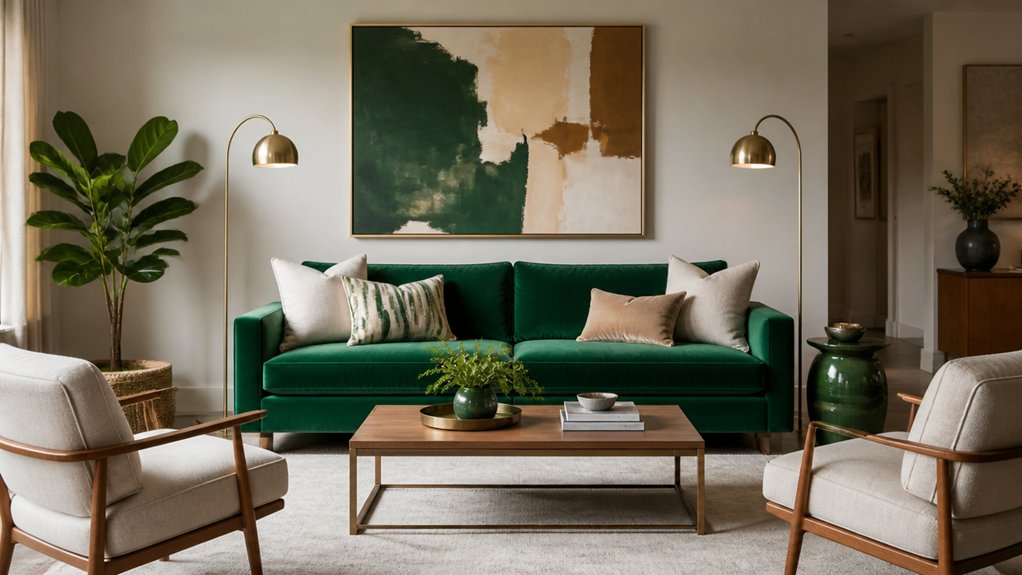
Although a statement sofa deserves to be the star, a few common styling missteps can make it feel disconnected or overwhelming. Don’t crowd it with oversized side tables or a busy rug; give it breathing room with clear walkways and a rug that frames, not fights. Avoid matching everything to the sofa—repeat one or two tones in art, pillows, and a throw instead.
Skip accessorizing accessories: too many trays, stacked objects, and tiny decor pieces read like clutter. Choose fewer, larger accents with strong shapes. Watch scale with lighting; a petite lamp beside a bold sofa looks flimsy.
Finally, nail seasonal styling without chaos—swap textiles and greenery, not core pieces, so your room stays cohesive year-round.
Conclusion
When you’ve got a statement sofa, let it lead like a lighthouse in your living room. Pull 3–5 colors from its fabric, choose paint that makes it glow, and place it where it commands the view. Anchor it with a properly sized rug, then layer lighting to spotlight shape and texture. Add art that echoes its era, and repeat key tones in shelves and accents. Skip clutter, mismatched scales, and competing “stars.”