

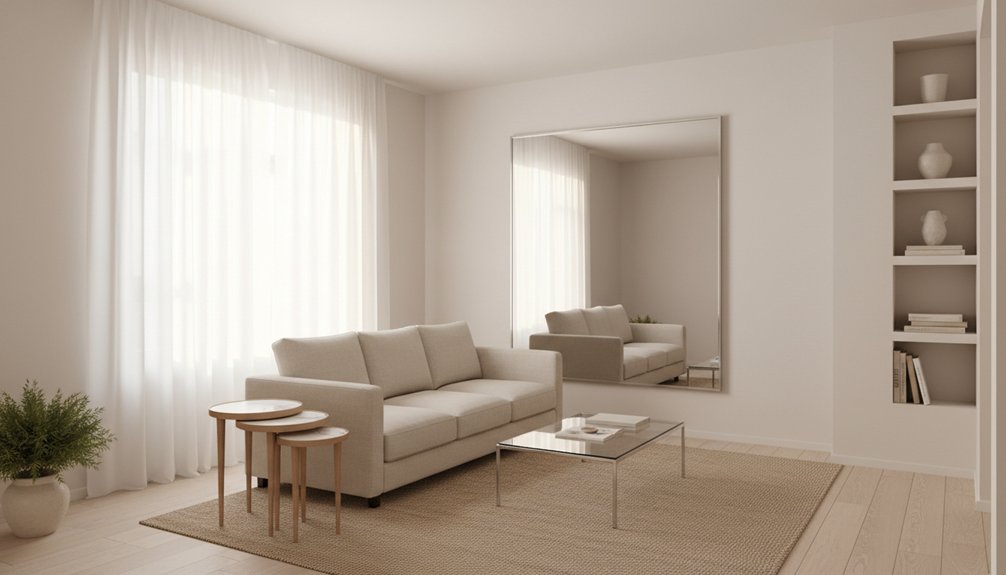
Make a small room feel bigger by tightening your layout first: keep a 30–36 inch path, float furniture, and zone areas with a properly sized rug. Brighten with high-LRV off-whites or warm greiges, paint trim close to wall color, and hang curtains high and wide. Layer ambient, task, and accent lighting on dimmers, then add a mirror opposite a window to bounce daylight. Choose leggy, open-base pieces and go vertical with shelves—more upgrades ahead.
Key Takeaways
- Plan a clear 30–36 inch walkway and choose properly scaled, multi-use furniture to reduce clutter and improve flow.
- Paint walls, trim, and doors in consistent light, high-LRV tones to reflect daylight and minimize visual breaks.
- Layer ambient, task, and accent lighting on dimmers to brighten corners and add depth without overcrowding.
- Place mirrors opposite windows or long sightlines to bounce light and visually extend the room.
- Hang curtains high and wide, use larger rugs, and pick open-base furniture on legs to create height and airiness.
Fix Your Small-Room Layout First (Paths + Zones)
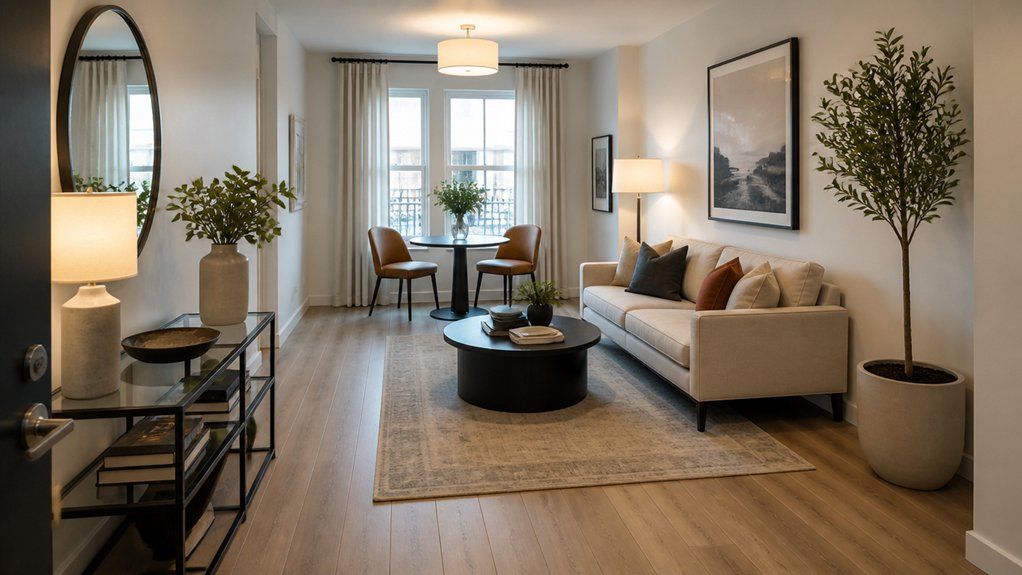
Before you buy anything new, fix your small-room layout by mapping clear paths and defining zones. Walk the room and mark a 30–36 inch circulation lane from entry to closet, window, or balcony; that’s Path optimization.
Pull furniture off the lane, then angle or float key pieces to keep sightlines open. Use Room zoning to give every square foot a job: a reading corner, a work perch, a dining spot.
Anchor each zone with a tight rug size, a single task light, or a slim console instead of extra tables. Favor nesting stools, wall-mounted shelves, and storage ottomans that serve two roles.
Keep cords, bags, and shoes contained so routes stay clean. Measure twice, move once.
Choose Light Paint Colors for a Bigger Look
Once you’ve nailed the layout, you can make the room read larger fast with light paint colors that bounce daylight and soften hard edges. Stick to airy off-whites, warm greiges, pale taupes, and whispery pastels (think modern clay, misty blue, or soft sage) to keep things current without feeling stark.
Use a consistent light tone across walls and trim, choose a higher-LRV finish where you need more lift, and test swatches in morning/night light so you don’t lose brightness.
Benefits Of Light Hues
Why do light hues make a room feel bigger? They boost light reflection, bouncing daylight and lamp glow across walls so edges read farther away. With fewer harsh shadows, corners soften and the ceiling feels higher.
Color psychology matters too: pale tones signal calm, cleanliness, and openness, so your brain interprets the same square footage as less cramped. You’ll also notice better visual continuity; when walls, trim, and large surfaces stay in a close tonal range, your eye doesn’t stop at strong contrast lines, so the room “stretches.”
Light hues are trend-friendly with minimalist and Japandi looks, yet practical for small homes: they show clutter faster, nudging you to edit, organize, and keep surfaces clear. That restraint makes space.
Best Shades For Space
Although any pale wall will lift a room, you’ll get the biggest “extra space” effect from light shades with the right undertone for your exposure.
In north-facing rooms, pick warm off-whites, creamy ivories, or pale greige to counter cool light.
In south-facing rooms, try crisp white, soft blue-white, or whisper gray to keep things clean and airy.
Use Color psychology: warm tints feel welcoming and expansive, while cool tints read calm and retreating, so the edges seem farther away.
For modern, small-space polish, choose low-chroma pastels like dusty blush, misty sage, or barely-there sand.
Check Shade durability by selecting a washable, stain-resistant formula in the same light family, so scuffs don’t force touch-ups that break the seamless look.
Painting Tips For Brightness
When you want a room to read brighter and bigger, treat paint like a light tool: choose high-LRV (light reflectance value) colors, then apply them to maximize bounce. Stick to warm whites, pale greiges, or airy pastels with a clean undertone so daylight doesn’t turn them dingy.
Paint the ceiling one step lighter than walls to lift height, or match it to erase edges for a seamless volume.
Control color contrast: keep trim close to wall color for fewer visual breaks, or use crisp white trim only if windows are large. Pick the right paint finish—eggshell on walls for soft reflectance, satin in high-traffic zones, and flat on ceilings to hide flaws.
Don’t forget doors; paint them to match for continuity.
Keep Contrast Low for Seamless Walls
To make your walls feel continuous and expansive, keep contrast low between paint, trim, and built-ins. Pick one undertone and repeat it across surfaces, so edges dissolve instead of popping. Soft greige-on-greige or warm white-on-cream reads larger than stark black-and-white color contrast.
Paint baseboards and door casings the same sheen and color as the wall for a modern, gallery-like wrap.
Use wall texture to add interest without breaking the visual plane: limewash, matte plaster, or a subtle micro-stripe can elevate a small room while staying quiet.
If you need definition, choose a slightly deeper value for built-ins, not a new hue. Keep hardware simple and finishes consistent, and your perimeter will feel longer and calmer.
Layer Ambient, Task, and Accent Lighting
Low-contrast walls set a calm backdrop, but layered lighting gives that calm dimension. Start with Ambient layering: a slim flush-mount or track head aimed upward to bounce light across the ceiling and soften corners. Add dimmers so you can keep the room bright without glare, and choose warm-neutral LEDs (2700–3000K) for a clean, modern tone.
Next, anchor function with task lighting where you actually work: an under-cabinet strip in a kitchenette, a swivel sconce by the bed, or a clamp lamp on a desk.
Finish with accent lighting to sculpt depth—LED tape along shelves, a narrow-beam picture light, or a floor uplight behind a chair. Keep fixtures petite, cords hidden, and bulb color consistent.
Hang Mirrors Opposite Windows and Sightlines
Place a mirror directly opposite your best window and you’ll bounce daylight deeper into the room, cutting the need for extra fixtures.
Angle it to catch long sightlines—down a hall or toward a focal wall—so the space reads longer and cleaner.
Choose a thin-frame or frameless style and you’ll stack reflections for an instant depth illusion that feels current, not cluttered.
Maximize Natural Light
Want your rooms to feel brighter without adding a single bulb? Start by treating daylight like premium square footage. Hang a mirror directly opposite your largest window so it bounces light deep into the room, then keep its frame slim to avoid visual bulk.
Choose window treatments that stack back fully—ceiling-mounted tracks, sheers, or woven shades that disappear above the glass—so you don’t choke the opening. Keep sills clear; even a tall plant can block usable light.
Paint nearby trim in a crisp, high-LRV white to amplify what comes in. At night, layer light fixtures: a flush mount plus a plug-in sconce keeps the ceiling open and eliminates floor-hogging lamps.
Clean glass quarterly; haze steals brightness.
Reflect Long Sightlines
Even if you can’t widen a hallway or open up a boxy living room, you can make it read longer by mirroring the view. Place a mirror directly opposite a window to bounce the brightest scene across the room and extend your long sightlines.
In an entry or corridor, align the mirror with the main axis from the front door to the farthest wall so your eye travels without stopping. Keep the frame slim or frameless for a cleaner, more current look, and hang it at eye level to maintain visual continuity.
Avoid clustering art around it; let the reflection do the work. If you’re tight on floor space, lean a tall mirror behind a console. Choose low-distortion glass.
Create Depth Illusion
How do you make a tight room feel deeper without moving a single wall? Hang a mirror opposite your brightest window to bounce daylight and extend the view, instantly boosting depth perception.
Position it so it captures the longest sightline—down a hallway, past a doorway, or toward a focal point—so your eye reads “more room.” Choose a slim frame or a frameless edge for a cleaner, trend-forward look that won’t crowd the wall.
For visual layering, flank the mirror with a narrow sconce or a tall plant, then keep nearby decor low-profile. Mount the mirror at eye level, and avoid reflecting clutter; edit what’s in the bounce zone.
If you can, angle it slightly to catch sky, not storage.
Choose Properly Scaled Furniture for Small Rooms
Because every inch counts in a small room, you’ll get a cleaner, more modern look by choosing furniture that’s properly scaled to the space instead of simply buying “smaller” pieces. Start by measuring wall lengths, clear walkways, and door swings, then map a simple floor plan so you can scale furniture with intention.
Aim for proportionate pieces that match the room’s visual weight: a streamlined sofa with the right depth beats a loveseat that still looks bulky. Keep seat heights consistent to reduce visual chop, and choose narrower arms, tight backs, and slim profiles.
Use one larger anchor piece paired with compact companions to avoid a cluttered, mismatched feel. You’ll gain breathing room without sacrificing comfort or function.
Pick Leggy, Open-Base Furniture to Add Air

Once you’ve nailed the right scale, make the room feel even lighter by swapping bulky bases for furniture that sits on legs or an open plinth. Leggy furniture exposes more floor, so your eye reads uninterrupted surface and the footprint feels smaller.
Choose sofas and chairs with tapered legs, a slim sideboard on a raised frame, or a bed with clearance underneath to keep sightlines clean.
Prioritize an open base design in pieces you use most: coffee tables, media consoles, and nightstands. Keep finishes visually quiet—light oak, matte black, or clear acrylic—and match leg tones for cohesion.
If you need storage, pick units with a recessed toe-kick or airy sled legs, not skirted fronts. You’ll get breathing room without sacrificing function.
Go Vertical With Shelves and Wall Storage
Even if your floor plan won’t stretch, you can steal square footage from the walls by stacking storage upward. Start with Vertical storage that runs to the ceiling: tall bookcases, rail systems, or modular wall tracks keep essentials off the floor and draw the eye up, making the room feel taller.
Use wall shelving over desks, sofas, and doorways to capture dead zones. Keep it light-looking with slim brackets, floating shelves, or tonal finishes that blend into paint. Group items in tight zones—books on one shelf, baskets on another—so the wall reads organized, not crowded.
Add hooks and pegboards near the entry or kitchen for grab-and-go storage. Leave a little negative space between stacks to keep things airy.
Add Double-Duty Pieces (Storage Beds, Ottomans)
Choose double-duty pieces so every square foot earns its keep: a storage bed hides off-season linens while freeing up floor space.
Add a hidden-storage ottoman that gives you extra seating and a quick stash spot for throws, remotes, and chargers.
Finish with convertible pieces—like nesting tables or a bench with bins—so you keep surfaces clear and clutter stays out of sight.
Storage Beds Maximize Floor Space
One swap can free up a surprising amount of floor space: trade a standard bed frame for a storage bed with drawers or a lift-up platform, and you’ll tuck off-season clothes, extra linens, or shoes out of sight without adding a bulky dresser.
Choose full-extension drawers so you can reach items from the side without yanking bins into the walkway. If your room’s tight on clearance, pick a lift-up platform with gas struts; it opens smoothly and keeps the footprint clean.
Match the bed’s base to your wall color or flooring for a lighter visual profile, and skip a bed skirt so the streamlined lines read modern.
Treat it as multi functional furniture: one piece replaces under-bed boxes and extra cabinetry. It’s one of the smartest space saving solutions you can buy.
Hidden-Storage Ottomans Add Seating
Where do you stash the clutter that never quite earns a drawer—throws, remotes, chargers, board games—without sacrificing seating? Choose an upholstered ottoman with hidden storage, and you’ll get a tidy room plus an extra perch.
Go for a lift-top or hinged lid that opens smoothly, with a safety stop so it won’t slam. Measure clearance: you want at least 16–18 inches from sofa to ottoman for easy pass-through.
Match scale to your seating depth, and pick a slim profile with tapered legs to keep sightlines open. Use a tray on top to create a stable surface for drinks.
In a small space, ottoman seating keeps everything close, contained, and calm.
Convertible Pieces Reduce Clutter
How do you keep a small room feeling intentional when every extra item wants its own footprint? You choose Convertible furniture that works overtime, so one piece replaces two or three.
Start with a storage bed: drawers or a lift-up platform swallow off-season linens, shoes, and bulky bags, keeping your closet lean. Add a compact ottoman that flips to a tray, tucks under a console, and still hides cords, remotes, or workout bands.
Look for slim profiles, concealed hinges, and easy-open hardware so you’ll actually use the storage daily. Prioritize pieces on casters or with fold-flat parts to reconfigure fast for guests.
This approach delivers real clutter reduction without sacrificing style or circulation.
Use Curtains and Rugs to Stretch Proportions
Ever wonder why some rooms look taller and more polished with the same footprint? You can fake square footage by stretching lines with curtains and rugs. Hang drapery high—close to the ceiling—and extend the rod 8–12 inches past each window so panels stack off the glass.
Choose Curtain styles that fall to the floor: ripple-fold, pinch-pleat, or sleek sheers for modern lift. Keep colors tonal to reduce visual breaks, and skip busy valances.
On the floor, go bigger than you think. A rug that tucks under the front legs of seating makes the layout read as one zone. Use rug patterns with lengthwise stripes or subtle geometrics to pull the eye across, not chop it up.
Anchor with a low-pile, easy-clean weave.
Conclusion
Tight space? You’ll make it feel vast by fixing flow first—clear paths and smart zones. Stick with light, low-contrast colors so walls visually wash outward. Layer lighting—ambient, task, accent—to banish boxy shadows. Place mirrors to bounce daylight down key sightlines. Choose leggy, lifted furniture for breathable floors, then build up with vertical shelves. Double-duty storage pieces keep clutter contained. Finish with curtains and rugs that stretch proportions—sleek, simple, spacious.